
Welcome to Technology Engineering
Welcome to the MSU Bachelor of Science in Technology Engineering (TechE) degree program. This innovative program, developed in partnership with industry engineering leaders, integrates technology, engineering, and AI to address the challenges at the intersection of hardware and software which are prevalent in our interconnected world.
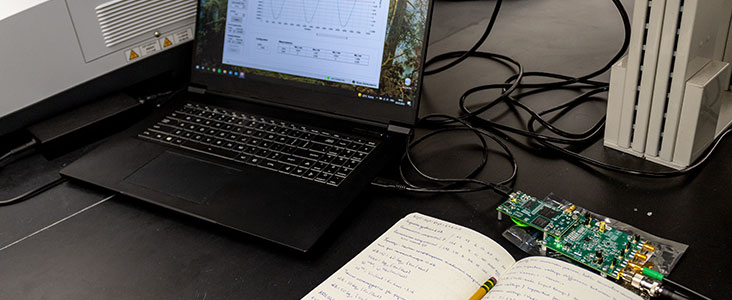
The Bachelor of Science Technology Engineering degree program cultivates innovative Spartan Engineers. Through immersive learning in our state-of-the-art labs, students delve into electrical circuits, embedded systems, robotics, hardware cybersecurity, sensors and signal processing, all with AI integrations. Additional focuses include Mechatronics, Embedded Cybersecurity, Semiconductors, and Smart Agricultural Systems, which all integrate mechanical and electrical systems with digital control, while developing secure solutions for engineered hardware and software.

Janet Brelin-Fornari
Welcome to the Bachelor of Science Technology Engineering (TechE) degree program at Michigan State University (MSU) College of Engineering! I am thrilled to serve as the founding director of this pioneering degree program as MSU continues its rich history of cultivating exceptional engineering talent.
Many of today's engineering challenges demand a blend of technology and engineering skills, as both hardware and software are integral to numerous modern products. To tackle these challenges, industries spanning mobility, communications, manufacturing, agriculture, and beyond, seek professionals with strong engineering problem-solving capabilities. Our Technology Engineering program is uniquely designed to equip engineers with the hands-on experience and theoretical knowledge required to address the contemporary engineering issues involving software and hardware integration.
We invite you to explore our innovative curriculum, state-of-the-art learning labs, and world-class faculty. Let us know if you have questions.
I eagerly anticipate welcoming you to the Spartan Engineering community.
GO GREEN!
Janet Brelin-Fornari, Ph.D., PE
Director
The Bachelor of Science in Technology Engineering (TechE) program represents a pioneering, multidisciplinary initiative that seamlessly integrates mechanical, electrical, and computer engineering with computer science, offering a truly innovative engineering experience. Courses such as Hardware Cybersecurity, Electronics and Embedded Systems Lab, Sensors and Signal Processing, and Robotics, Automation and Controls, leverage hands-on, real-world projects to integrate cutting-edge technologies with a strong foundational engineering mindset.
Principles, Topics, and Technologies within the courses include:
- Circuits
- Computer Aided Design (mechanical and electrical)
- Prototyping
- Project Management
- Data Science
- Multiple programming languages including Python, C++, and Assembly
- Embedded Systems, Internet of Things (IoT)
- Troubleshooting mechanical, electrical, and digital-controlled systems
Students choose a 16-credit concentration from Mechatronics, Embedded Cybersecurity, Semiconductors, or the integrated Smart Agricultural Systems minor:
- Mechatronics Concentration: The study of mechatronics combines mechanical engineering, electronics, controls engineering, and computer science. Core program courses in electronics and sensors are brought together with topics in machine dynamics, automation, and system control. Mechatronic systems are often used in robotics, automotive systems, medical devices, and consumer electronics.
- Embedded Cybersecurity Concentration: Embedded cybersecurity refers to the protection of electronic devices and systems that are interconnected and have computing capabilities. Core program courses in electronics, computer engineering, programming, and embedded systems are augmented with topics in network security, hardware cybersecurity, and operating systems. Embedded cybersecurity is essential in industries such as smartphones, biomedical devices, and autonomous vehicles as they integrate design strategies in software, hardware and data management to confront unauthorized access, attacks, or damage.
- Semiconductors Concentration: Semiconductors are materials, devices, and components at the heart of circuit assemblies, microchips, and microprocessors. Core electronics courses in digital logic, electronics, and embedded systems, are combined with topics in electronic materials, electronic failure analysis, and semiconductor manufacturing automation. Semiconductors are critical for virtually every modern industry and electronic device, serving as the foundational brains and power management systems of the global economy.
- Smart Agricultural Systems Minor: The minor in Smart Agricultural Systems, which is administered by the Department of Biosystems and Agricultural Engineering, is available for students who are interested in smart technology for management decision support and who plan to pursue careers in agriculture or natural resources. The minor, integrated into the Technology Engineering degree, provides an opportunity for students to gain a working knowledge of digital technologies necessary to monitor and manage aspects of agriculture, food, natural resources, and bioenergy systems along with the foundation of hardware and software integration found in the TechE core courses.
Visit Undergraduate Admissions for information on applying to the program today!
Visit Undergraduate Admissions for information on applying to the program today!
The Technology Engineering courses integrate hands-on, project-based learning with theoretical foundations in the state-of-the art learning labs. TechE Learning Labs includes the hardware and software cybersecurity studio opening in the STEM Building in Fall 2026 and the 20K square foot newly renovated Wilson Labs scheduled for completion in Fall 2027. The TechE Learning Labs include:
- Prototyping Lab: Additive and subtractive manufacturing processes including 3D printing, injection molding, , computer numerical controlled (CNC) machining, and circuit board printing. Computer Aided Manufacturing (CAM) and Simulation Lab: Computer Numerical Control (CNC) manufacturing processes and simulations
- Electronics, Sensors, and Embedded Systems Lab: Fundamental circuit design and analysis, embedded systems electronics, and sensors for system integration and testing needs.
- Hardware and Software Cybersecurity Range and Studio: network solutions, and computer hardware and software integration and security
- Robotics, Automation, and Mechatronics Troubleshooting Lab: Robotics, Assembly Systems, Automation sensors and controls
- Mechanics of Materials Lab: Testing of material properties under load including tension, compression, torsion and impact
The Advisory Board aids in facilitating the highest quality of Technology Engineering education delivered at Michigan State University. The Board reports to the Director of Technology Engineering and makes appropriate recommendations.
The Board
- Acts as an advisory group to the Director regarding specific issues.
- Advises the program to ensure that educational, research and outreach programs stay attuned to the needs of the Program stakeholders such as industry (private and public corporations), governmental bodies, academic institutions, nonprofits and the community.
- Advises on the undergraduate (and graduate) curriculum of the Program.
- Advises and assists the Program on ways to raise resources from Program stakeholders.
- Serves as an advocate to represent the Program’s interests to Program stakeholders and to the Administration of the University.
- Mentors Technology Engineering Program students.
Advisory Board
- Jeff Abell – professor of practice, University of Michigan
- Jason Beaudin - executive director, Educational Technology, Michigan State University
- Kenneth Bonello – vice president of engineering, Humanetics (retired); Bonello Consulting LLC
- Stacy Chung – engineering manager, Daimler Truck North America
- Heather Dashner – global industrial engineering manager, Ford Motor Co.
- Tre Dipassio - principal research engineer, Harman International
- Steve DuMont – engineering group manager, General Motors Co.
- Jared Fisher – director of data intelligence services and integration, Stellantis
- Victor Hyde – senior manufacturing engineer, Steelcase
- Chad Ivan - sales and applications manager, DTS
- Sheryl Janca - senior program manager, Autoliv ASP
- Jay Judkowitz – director of product and engineering, autonomous mobile robots, Rockwell Automation
- Leah Kunzelman – director supply chain management, Eaton Corporation
- Eyad Nayef – President ZF LIFETEC Japan, ZF LIFETEC
- Alison Peterson - director of mobility initiatives, Washtenaw Community College
- Dean Sabelhaus - director for career technical education, Chippawa Valley Schools
- David Sanders - general manager – General Motors partnerships, Microsoft
- Matt Zaleski - senior cybersecurity engineer, GM Financial
- Louis Zednick - application engineer, Autoliv
History
The Technology Engineering (TechE) program was launched at Michigan State University in 2024 with the first TechE graduates in the 2026/2027 academic year. Developed from the ground up with extensive input from industry, TechE graduates aim to bridge the communication gap between engineers and computer scientists across product development teams. The program curriculum was developed, with extensive industry input, to offer a unique blend of engineering and computer science, tailored to address the modern engineering challenges of coding and digital control integrated into modern engineered systems.