13 Engineering faculty honored at 2026 MSU Investiture
Read ArticleThirteen Michigan State University College of Engineering faculty members were among those honored Sept. 29 during MSU’s 2026 Faculty Investiture and State of the University at the Wharton Center for Performing Arts.
MSU AI innovation supports 2.2M US workers exposed to toxic dust
Read ArticleFrom coal miners and construction crews to engineered stone countertop fabricators and foundry workers, more than 2.2 million U.S. workers inhale fine particles of rock, sand or coal every day on the job. After years of exposure, trapped dust can cause thick scar tissue to build up inside the lungs leading to long-term lung damage commonly known as black lung or silicosis.
NIH awards multi-university team over $4M to improve women’s health
Read ArticleBacked by a new $4.6 million award from the National Institutes of Health, or NIH, Michigan State University researchers are launching a novel project to transform how medications are developed and prescribed for women. This is the first installment of an award worth up to $12.8 million over three years. Researchers from Rutgers, Emory, Tulane, University of Colorado Anschutz, University of Michigan and University of Utah are collaborating with the MSU team to accomplish this goal, which the lead scientist describes as a moon shot.
How insects could help detect PFAS contamination
Read ArticleResearchers at Michigan State University have discovered that neurons in a locust’s brain can distinguish among multiple PFAS compounds, including PFOS, one of the world’s most common “forever chemicals,” at environmentally relevant concentrations.
How mini hearts could help transform how we treat heart disease
Read ArticleAitor Aguirre doesn’t describe his work as futuristic. He describes it as necessary. For decades, scientists have relied on animal models to study heart disease, test drugs and understand how the human heart develops and fails. Those models have been invaluable, but they have limits. A mouse heart is not a human heart. Its electrical rhythms are different. Its physiology is different. Some of the most common human heart conditions simply do not unfold the same way in animals.
Sensor for seniors: Fixing a hidden flaw in wearable technology
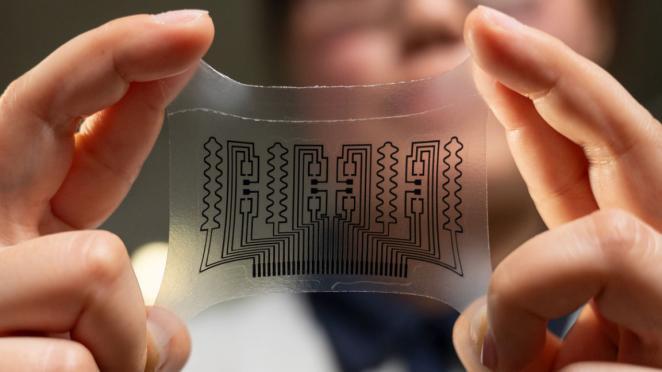
Read ArticleSkin-interfaced wearable health technology has a hidden flaw: Many systems work best on smoother skin, which tends to be on younger bodies — not the older adults who often need them most. This is because aging-related changes in skin, including wrinkles, thinning and dryness, can significantly impact the contact and data quality of wearable devices.
John Papapolymerou recommended as dean of MSU College of Engineering
Read ArticleAfter a national search, John Papapolymerou has been recommended as dean of the College of Engineering at Michigan State University, effective June 1, 2026. He will serve as dean designee prior to the June 12 meeting of the MSU Board of Trustees. Papapolymerou has served as interim dean since Oct. 1, 2024.
Eighteen Spartan Engineers honored at Undergraduate Research Forum
Read ArticleEighteen Michigan State University College of Engineering students received first-place awards at the 2026 University Undergraduate Research and Arts Forum (UURAF) at the Breslin Center in April. Students from 14 colleges participated in MSU's premier showcase for undergraduate research, scholarship, and creative activity.
MSU Engineering innovators honored at 2026 Innovation Celebration
Read ArticleFrom apple orchards and biomedical labs to wastewater systems, electric grids and drone training fields, Spartan Engineering innovation was well represented at the 2026 MSU Innovation Celebration. Hosted by the MSU Innovation Center on April 7 at the Henry Center for Executive Development, the annual event recognizes technologies, startups, research partnerships and inventions emerging from Michigan State University.
Nine Spartan Engineers named NSF Graduate Research Fellowship recipients
Read ArticleNine of the 21 Michigan State University students and alumni selected for the National Science Foundation Graduate Research Fellowship Program are from the College of Engineering.