

Skin-interfaced wearable health technology has a hidden flaw: Many systems work best on smoother skin, which tends to be on younger bodies — not the older adults who often need them most. This is because aging-related changes in skin, including wrinkles, thinning and dryness, can significantly impact the contact and data quality of wearable devices.
Now, engineers at Michigan State University have developed a soft, flexible wearable sensor platform called AdapSkin that dramatically improves how the body’s electrical signals are captured, helping artificial intelligence systems more accurately interpret movement and control prosthetic devices.
In testing, the technology improved gesture recognition accuracy in older adults from roughly 60% to more than 97%.
Over the past several years, Jinxing Li, Red Cedar Distinguished Assistant Professor in the College of Engineering and MSU’s Institute for Quantitative Health Science and Engineering, has been developing wearable systems designed to better interface with the human body across a wide range of skin conditions and ages.

The breakthrough was not a new AI system but an improvement in the quality of biological data going into it.
Most existing wearable sensors rely on rigid electrodes that struggle to maintain stable contact with aging skin, which tends to become thinner, drier and less elastic over time. That poor connection weakens electrical signals, introduces noise and reduces the accuracy of systems designed to interpret muscle activity.
AdapSkin solves that problem by using soft, stretchable electronics that conform closely to the skin and maintain stable contact and skin comfort during movement. The system also reduces “motion artifacts” — signal disruptions caused when conventional electrodes shift during motion or exercise.
“Aging skin changes signal quality,” Li said. “We’ve shown that soft electronics like AdapSkin perform significantly better on older adults’ skin than current commercial electrodes.”
Unlike conventional wearable systems that record signals from only a few points on the skin, AdapSkin uses dense arrays of electrodes to create a more detailed map of muscle activity. Those high-resolution recordings allow researchers to more precisely distinguish between subtle movements, including individual finger motions.
The technology records surface electromyography, or sEMG, signals, which are electrical signals generated when muscles contract and relax. Because those signals reflect instructions sent from the brain to the muscles, they can be used as a noninvasive bridge between the human body and machines.
“With better data, we can better understand the brain’s intended motion,” Li said. “That directly improves the precision and personalization of wearable technology.”
Using the same AI systems and hardware, the higher-quality signals generated by AdapSkin enabled dramatically more accurate real-time gesture recognition and robotic control.
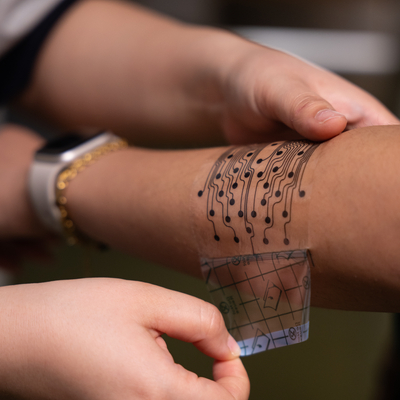
That capability is especially important for prosthetics and rehabilitation. Even after limb loss, the brain continues sending signals to the remaining muscles in the forearm. AdapSkin is sensitive enough to detect those faint electrical patterns, allowing users to control prosthetic devices more naturally by intending a movement.
The technology could also improve stroke rehabilitation and neuromuscular recovery by giving clinicians clearer, more reliable information about how muscles are functioning over time. The sensors remained stable during long-term wear and movement, an important step for real-world rehabilitation and monitoring applications.
More broadly, the findings highlight a growing challenge in wearable technology and artificial intelligence: Systems are only as good as the data they receive. Researchers say many wearable technologies are unintentionally optimized for younger users, even though older adults may rely on them the most.
As populations age, Li said designing technology that works reliably across different bodies and skin conditions will become increasingly important for healthcare, rehabilitation and future human-machine interfaces.
The research was published in the journal Device and supported by the National Science Foundation.
Lead contributing authors include Vittorio Mottini and Liuxi Xing at MSU. Additional collaborators include Charlie Meilinger, Soham Inamdar, Xiang Calvin Chen, Jiaqi Wang, Yi Xing, Jack Darbonne, Zhengxu Tang, Yunnuo Zhang, Christopher H. Contag and Ruiguo Yang from MSU and Mi Zhang from The Ohio State University.
Story courtesy of MSUToday.
MSU College of Engineering Media and Public Relations page