October 2018 Media Report
Read ArticleThe race is on to create cheap materials to store energy for the U.S power grid, said Mechanical Engineering Department Chair James Klausner. MSU is sharing a $2 million award from the U.S. Department of Energy's Advanced Research Projects Agency-Energy (ARPA-E). "We think we can return electricity to the grid at less than 5 cents per kilowatt hour," he said.
Advancing cancer research
Read ArticleResearchers from Michigan State University and Stanford University have created a computer simulation, validated by experimental results, to help design drug-delivery nanoparticles that carry cancer-fighting medicines directly to tumors, while minimizing the potential side-effects on healthy cells.
Brave new medical discoveries
Read ArticleImagine being able to learn the likelihood of your unborn child someday developing a disease such as cancer, heart disease or diabetes. And what if, in addition to arming you with that information, doctors were able to repair the defective genes that are the root cause of the disease?
August 2018 Media Report
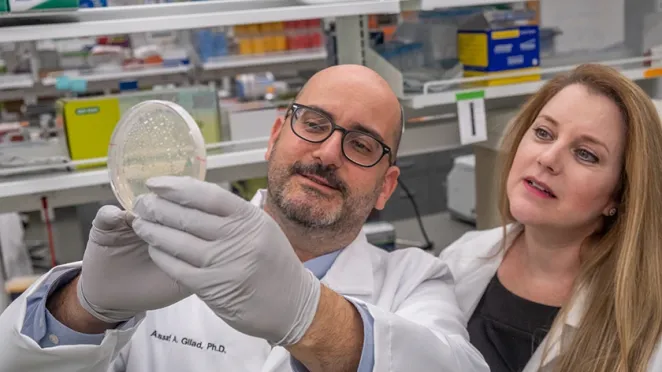
Read ArticleA two-story news package on research by Assaf Gilad, professor of biomedical engineering and radiology, and Galit Pelled, professor of biomedical engineering, radiology and neuroscience, is telling readers about ongoing work in the Department of Biomedical Engineering.
2018 Von Ehr Scholars
Read ArticleThree incoming students in the Michigan State University College of Engineering have been selected to receive Von Ehr Scholarships.
Welcome ADS & UDS Scholars
Read ArticleSix of the 22 incoming students awarded an MSU Alumni Distinguished Scholarship (ADS) or University Distinguished Scholarship (UDS) for 2018-19 are headed to the College of Engineering.
$1.3 Million NIH grant
Read ArticleMichigan State University engineering researchers are working to create synthetic biological devices inside the cells of mammals that will enable new treatments for chronic and uncured diseases.
$360,000 NSF grant
Read ArticleExperts in biomedical engineering and electrical and computer engineering at Michigan State University are collaborating on the limitations of wide-field tumor imaging in the fight against breast cancer.
Erin Purcell and Joseph Salatino
Read ArticleMedical advances in the use of brain implants are strengthening treatment possibilities for brain injuries and neurological diseases, such as Parkinson's and Alzheimer's. Unfortunately, using implants still has a major drawback - scar tissue that forms around the implant severely limits its function.