




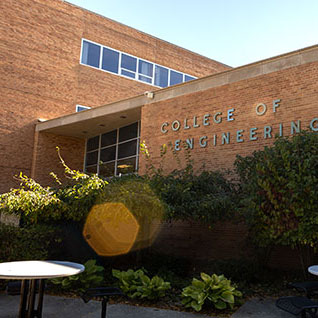
Michigan State University is the nation’s premier land-grant university and one of the top research universities in the world. The College of Engineering is among the university’s founding disciplines and one of the largest academic units. Degrees granted by the college are sought-after and valued in the marketplace, with more than 6,800 students, 341 faculty, and collaborative partners in industry and government working together to deliver the technology talent and innovation needed to drive the economy of Michigan and beyond.
Card Section
By the Numbers...
Featured News

Research Spotlight: Microrobots combat cancer and clots with pinpoint accuracy
Clinicians treating cancer and blood clots must balance the risk of medical interventions with their life-saving benefits. Biopsies to collect tissue for testing, ablations to kill diseased cells, and surgery or catheters to remove blood clots are effective but they’re also invasive. New microrobots – smaller than the diameter of a human hair – could reduce the need for invasive procedures.
Read Full ArticleLatest News
-

MSU-Irish researchers collaborate on next-gen wireless communications
Read ArticleA new U.S. – Ireland research partnership, led by electrical engineering professors at Michigan State University, will work to improve wireless communications through location-specific “communications pockets” for more private, secure and efficient wireless communications. The project has the potential to improve next-generation wireless systems, like 5G and 6G.
-

MSU student entrepreneurs land deal on ABC’s ‘Shark Tank’
Read ArticleMichigan State University College of Engineering student entrepreneurs Madhav Aggarwal and Tanvi Gadamsetti, co-founders of BRCĒ, secured a $300,000 investment during their appearance on ABC’s “Shark Tank,” which aired on March 4, 2026, bringing their student-built venture from campus to one of the largest stages for entrepreneurship.
-

Research Spotlight: Slippery surfaces that speed up life-saving diagnostics
Read ArticleMicrofluidic devices can reveal infections, track treatment response, and guide personalized therapies. They power many of today’s vital medical tests, but if the fluid hesitates or sticks to the surface, results can be skewed, take longer, and cost more to produce.


