Third annual Engineering Three Minute Thesis competition set for April 10
Read ArticleResearch can take years to complete. Explaining it clearly to a broad audience in just three minutes is another challenge altogether. That challenge will take center stage Friday, April 10, when Michigan State University’s College of Engineering hosts its third annual Three Minute Thesis (3MT®) competition from 2 to 4 p.m. in Room 115 of the International Center. The event is open to the public.
Four Engineering faculty to receive All-University Awards
Read ArticleFour College of Engineering faculty members are among 37 Spartans who will receive All-University Awards at Michigan State University on Tuesday, April 7, at 4:30 p.m. at the Breslin Center Hall of History.
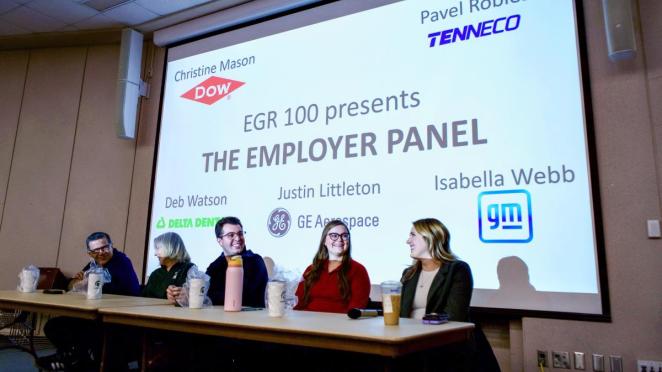
“I designed that”: Alumni return to EGR 100 to connect campus experiences to real-world careers
Read ArticleIn EGR 100: Introduction to Engineering Design, students don’t just learn how to build a solution, they learn how to build with people. Team dynamics, deadlines, tradeoffs and communication are part of the work from day one.
Narayan receives SPE Fellow of the Society award
Read ArticleAn internationally recognized chemical engineer at Michigan State University will be honored in March by the Society of Plastics Engineers (SPE) for his pioneering work in sustainable plastics and his significant contributions to shaping the global plastics industry.
FRIB inaugurates K500 Chip Testing Facility
Read ArticleThe Facility for Rare Isotope Beams or FRIB at Michigan State University today marked the inauguration of the K500 Chip Testing Facility or KSEE, expanding U.S. capacity for radiation effects testing of advanced microelectronics used in spaceflight, defense, wireless communications, and autonomous systems.
Spartan Engineering contributes to MSU’s top producer status for Fulbright Scholars
Read ArticleThe College of Engineering helped Michigan State University remain a top producer of Fulbright Scholars – the U.S. government’s premier international academic exchange program – in 2025-26.
Spalding family gift fuels cross-collaborative innovation
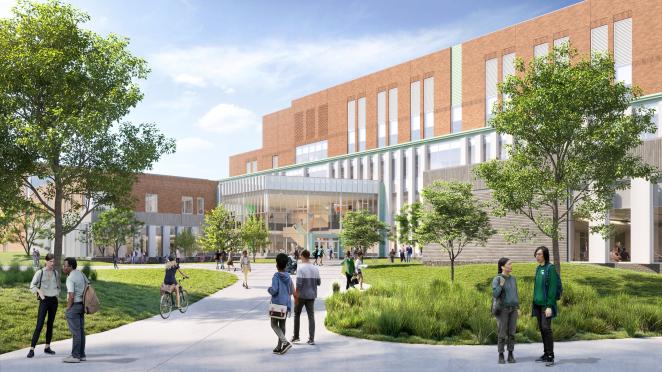
Read ArticleMichigan State University alumnus David F. Spalding, a 1967 mechanical engineering graduate, has made a transformative $10 million leadership gift to accelerate the Leinweber Center for Engineering and Digital Innovation, a facility designed to prepare Spartans to lead at the intersection of technology, creativity and impact.
Leinweber Foundation commits $50M to MSU to name the Leinweber Center for Engineering and Digital Innovation
Read ArticleMichigan State University announced a transformative $50 million commitment from the Leinweber Foundation to establish the Leinweber Center for Engineering and Digital Innovation, a landmark investment that will accelerate MSU’s leadership in education, research and workforce development across Michigan and beyond.
MSU Engineering honors 18 for contributions and service
Read ArticleThe Michigan State University College of Engineering has recognized 18 faculty and staff members for excellence in service and distinguished contributions.
Alumni reaching new career heights
Read ArticleSpartan Engineering alumni are continually advancing their professional roles – here is a look at seven recent career highlights for graduates of the College of Engineering at Michigan State University.