
In EGR 100: Introduction to Engineering Design, students don’t just learn how to build a solution, they learn how to build with people. Team dynamics, deadlines, tradeoffs and communication are part of the work from day one. That’s why Jenahvive Morgan, academic director for the First-year Engineering CoRe Experience, teaching specialist and EGR 100 instructor, regularly brings the ‘real world’ into the classroom.
Morgan teaches the first engineering course to roughly 1,800 incoming students each year, using hands-on, team-based projects that help students build confidence and connection early. “In EGR 100, we have students interact with each other in both their design work and their problem solving,” Morgan said.
On Friday, Feb. 20, Morgan invited a group of College of Engineering alumni back to EGR 100 for a candid panel discussion that reinforced a message central to the course: engineering success is built through hands-on work, collaboration and community. They explored what engineering work looks like after graduation and how the experiences students build at MSU can shape what comes next.
“I love being able to go to the store and walk through the parking lot with my husband and be like, ‘Hey, I designed that. I worked on that. I’m responsible for this,’” said Isabella Webb (Electrical Engineering '22), now a design release engineer at General Motors responsible for exterior components.
From campus experiences to career confidence
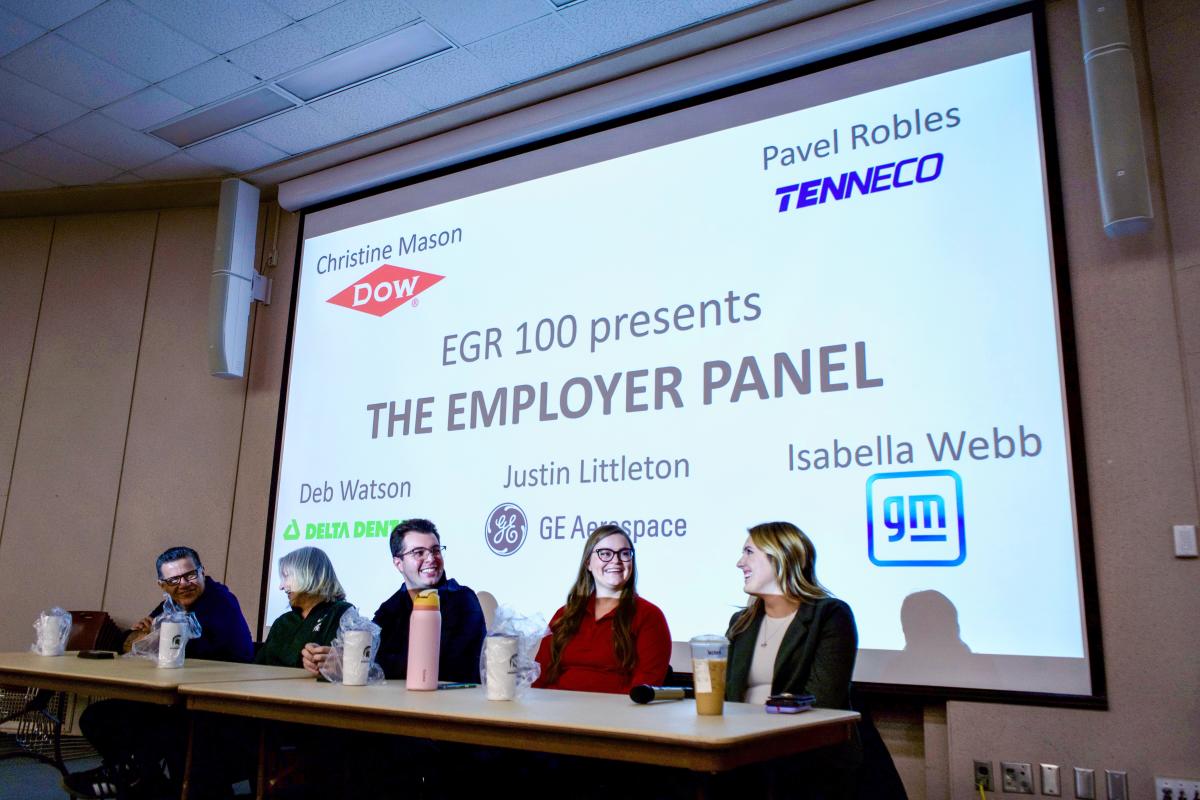
Morgan asked the panelists to “time travel” back to their first year at MSU, and the strongest theme wasn’t about having a perfect path but about learning how to persist through uncertainty with the help of people, resources and real experience.
Panelists work across various industries, but all returned to the same idea: the classes matter; but the community, involvement and real experiences around those classes are what helped them grow into engineers.
Webb told students that early doubts are normal, and that finding a support system made up her mind to persist. She credited Phi Sigma Rho, a sorority for women in engineering, with giving her a place to connect with people who understood the rigor of the program and a space to reset. “First of all, you don’t have to be perfect…” she said, encouraging students to prioritize their wellbeing as they take on challenging coursework.
Christine Mason (Chemical Engineering '20), now a senior production engineer at Dow, shared that building good study habits and a consistent group of friends made all the difference. Mason also pointed to MSU resources that helped her make decisions with clarity, including the Career Center, and said a multi-rotation co-op experience helped her learn what she enjoyed, and what she didn’t, before graduating and entering industry.
Justin Littleton (Electrical Engineering '24), now at GE Aerospace in the Edison Engineering Development Program, described how hands-on involvement at MSU helped connect classroom concepts to real engineering work. He encouraged students to find a club or project space where they can apply what they’re learning while building relationships at the same time. Littleton credited the MSU Solar Racing Team with giving him direct experience in design, testing and verification - and with building friendships that lasted beyond graduation.
Deb Watson (Computer Science '93), senior director of enterprise data at Delta Dental of Michigan, emphasized that growth often comes through discomfort, especially for students who don’t yet feel confident. She shared that she didn’t always feel comfortable asking for help as an undergraduate but later realized that community and vulnerability can be the difference-maker. “The best learning I have ever gotten is every mistake I have ever made,” Watson said, encouraging students to treat setbacks as information and to keep building forward.
And Spartan supporter Pavel Robles (Tenneco), underscored that resilience is a skill students practice repeatedly at MSU through team projects, labs and hard semesters, and that it continues into professional life. “We fail, we learn, and we move on,” he told students.
Résumé reality: you have about 30 seconds
Students prepare résumés in EGR 100, so panelists offered useful advice: keep it clean, easy to scan, and focused on experiences that show initiative and teamwork.
Across the panel was an emphasis that the experiences students build outside the classroom — often become the clearest proof of readiness later. As Littleton put it, “Try solving the problem as many times as you can… until you’re confident that you can just pick it up,” a mindset he said carries directly into work.
One panelist framed the reality this way: “You have about 30 seconds to catch somebody’s attention on your résumé.” The recommendation: highlight projects, involvement and clear goals early — and don’t let a lack of formal experience stop you from telling a strong story.
In the end, the alumni panel connected the dots between classroom projects and career success: communicate early, stay involved, learn from feedback, and lean on your community when things get hard — because that’s what engineering looks like in the real world, too.
Written by Austin Witt
MSU College of Engineering Media and Public Relations page