
Long before a concrete canoe touches the water, someone has to believe it can float.
Not as a metaphor. Not as a classroom thought experiment. As a real, student-built, competition-ready vessel that must be researched, designed, mixed, cured, lifted, displayed, defended before judges and raced against other universities.
At Michigan State University, that belief has been part of civil engineering student life for generations.
The MSU Student Chapter of the American Society of Civil Engineers has been active since 1921, tying today’s students to more than a century of professional preparation, hands-on learning and student-led engineering. In 1988, that tradition helped put MSU at the center of a national stage when the university hosted the first ASCE-sponsored National Concrete Canoe Competition, with races held at Lake Lansing.
By 1990, Spartan Engineers were no longer just part of that history. They were helping define it.
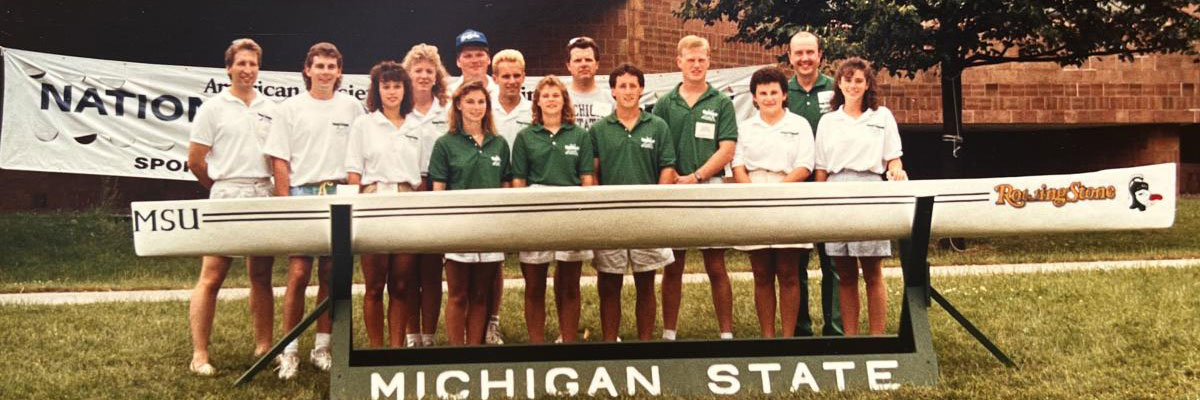
That year, MSU’s canoe, “Rowing Stone,” captured first place nationally in Buffalo, New York. Archival photos show the team standing proudly behind a long white canoe bearing “MICHIGAN STATE” along its side. A College of Engineering article from the time described 18 civil engineers working for a year under faculty advisors Mackenzie Davis and Mark Snyder to design, build and race a lightweight concrete canoe.
The win was not an isolated moment. ASCE records show MSU placed second nationally in 1989, won the national championship in 1990, placed second again in 1993, finished third in 1995 and returned to second place in 1996.
For the students involved, Concrete Canoe was part sport, part science fair, part design review and part rite of passage.
They mixed concrete light enough to float. They shaped hulls for speed and stability. They prepared technical reports, delivered presentations, answered judges’ questions and raced under pressure. They also learned, sometimes the hard way, that engineering does not end when the calculations are finished.
It has to work in the real world.
Today, a new generation of Spartan Engineers is working to carry that tradition forward.
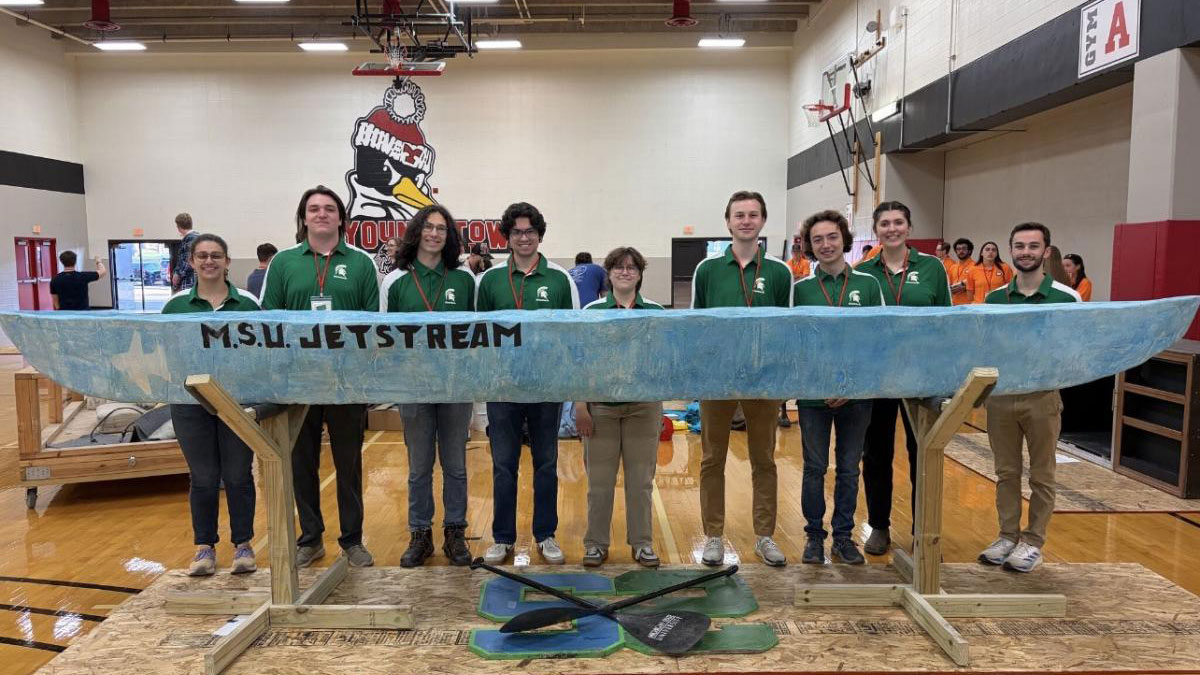
Grace Korkmaz, a senior majoring in civil engineering, served as co-captain of MSU’s Concrete Canoe team and led the paddle team. She said the group is now researching and redefining its 2027 canoe after competing at the 2026 ASCE Eastern Great Lakes Student Symposium, hosted by Youngstown State University in April.
“This is the second year back since 2019,” Korkmaz said.
That return matters.
Concrete Canoe is more than a race. Students are judged on a technical proposal, a technical presentation, the completed canoe and display, and race performance. The process asks students to think like engineers from start to finish research the materials, design the structure, manage a build schedule, test the product, explain the decisions and perform when the final product is on the line.
For Korkmaz and her teammates, the recent competition gave the team something even more valuable than a finished canoe. It gave them direction.
“We placed wonderfully in the races, for having never paddled before, and got to learn quite a bit on what elements of our canoe really helped us and what other elements we need to include next year based on other schools’ design,” Korkmaz said.
The team is already looking ahead. For the next canoe, members plan to refine the concrete mix design, simplify the mixture and explore new bulkhead designs to improve straightaway speed and turning capability.
MSU’s Concrete Canoe team operates with two captains overseeing the full project, along with team leads for mix design, construction and structural design. Those leads guide members through research, testing and build work. In the spring, when construction ramps up, the project becomes all hands on deck.
“We are the only competition team in our department, and we do all of our own research, design and construction in-house,” Korkmaz said.
That hands-on structure makes the team a natural extension of civil engineering education at MSU. A canoe hull becomes a lesson in materials science. A race becomes a lesson in teamwork. A judge’s question becomes practice for a client meeting. A failed test becomes design feedback. A heavy object that should not float becomes proof that students can move from theory to execution.
The archival images tell the same story across decades.
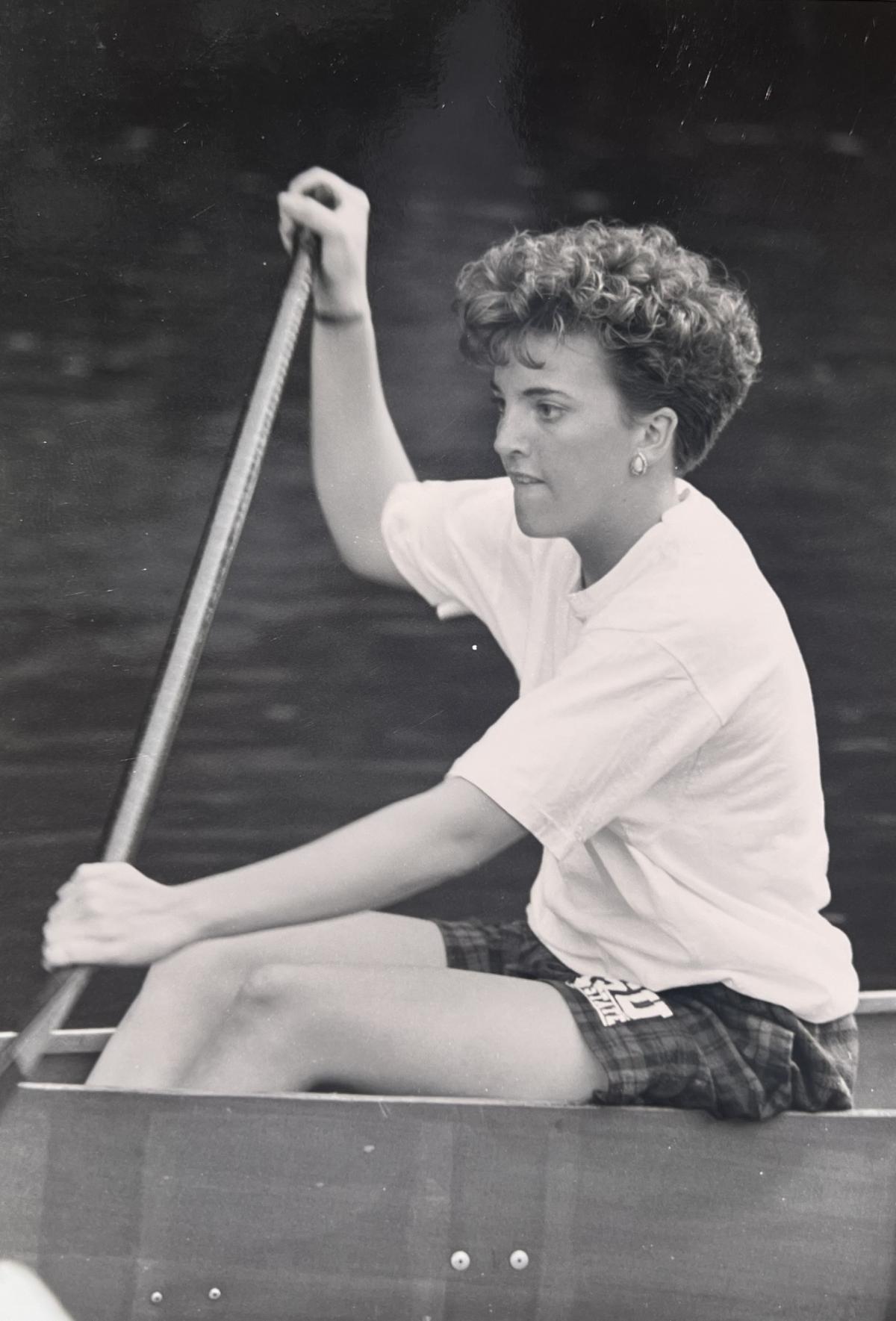
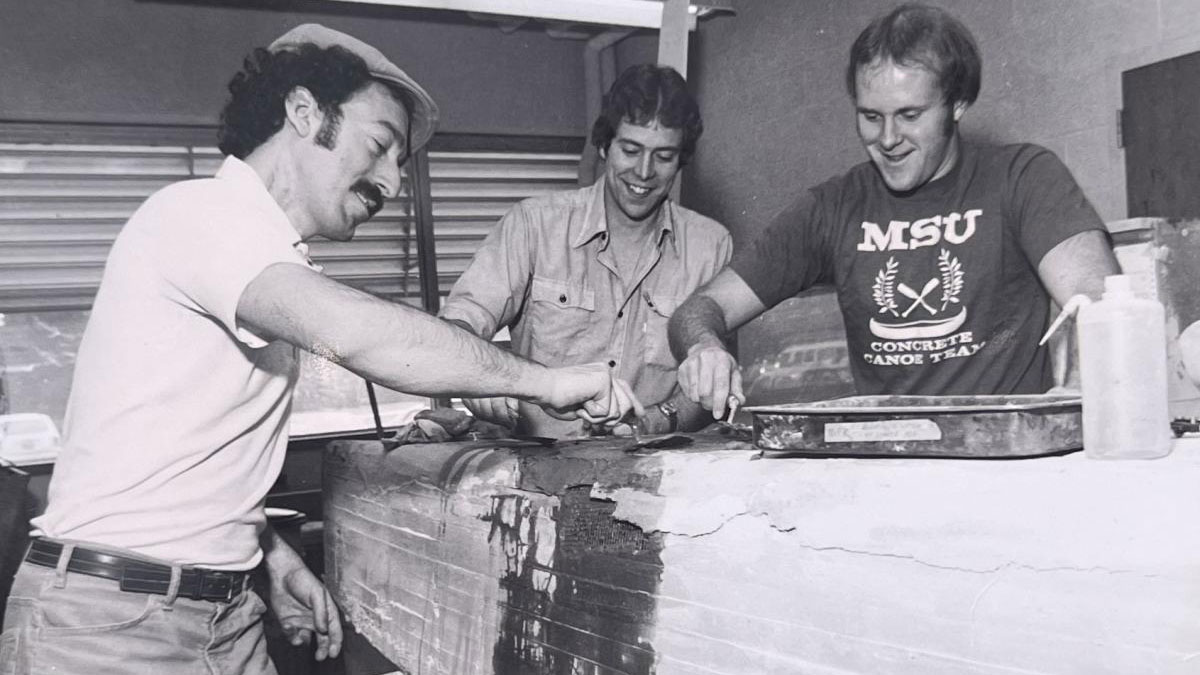
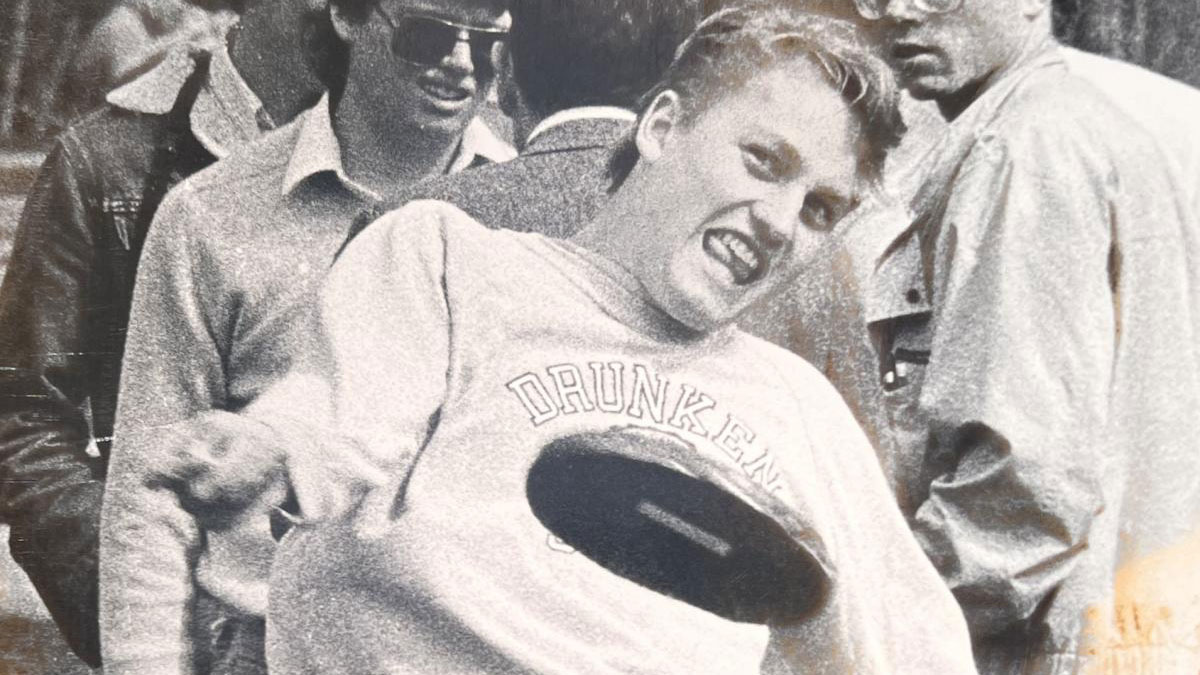
In one photo, students work around a canoe mold, brushes and tools in hand. In another, a paddler leans into the water, eyes fixed forward. In a 1986 Lansing State Journal clipping, MSU students are shown competing with concrete “Frisbees,” another playful but technically demanding civil engineering challenge. In the 1990s images, teams pose beside canoes with names like “Rowing Stone” and “CE Breeze,” smiling with the confidence of students who have built something strange, difficult and real.
The humor was part of the culture. So was the rigor.
Former faculty advisor Mackenzie Davis helped sustain MSU’s award-winning Concrete Canoe program and mentored the 1990 team that became national champion. His work with students helped turn a demanding competition into a lasting Spartan Engineering tradition.
That legacy now belongs to students like Korkmaz, who are rebuilding the team with the same mix of creativity and discipline.
The current group is not simply trying to recreate the past. It is trying to learn from it. MSU’s earlier teams showed what was possible when students were trusted with a complex, open-ended challenge. Today’s team is taking that lesson into the next design cycle, one mix, one mold, one test and one paddle stroke at a time.
The result is a story about more than concrete.
It is about confidence. It is about students learning to lead before they graduate. It is about the kind of engineering education that asks students not just to solve a problem on paper, but to stand next to the solution, explain it, defend it and race it.
A concrete canoe sounds impossible until students make it float.
At MSU, Spartan Engineers have been doing that for decades.
And now, the next race has already begun.
Written by Austin Witt.
MSU College of Engineering Media and Public Relations page