
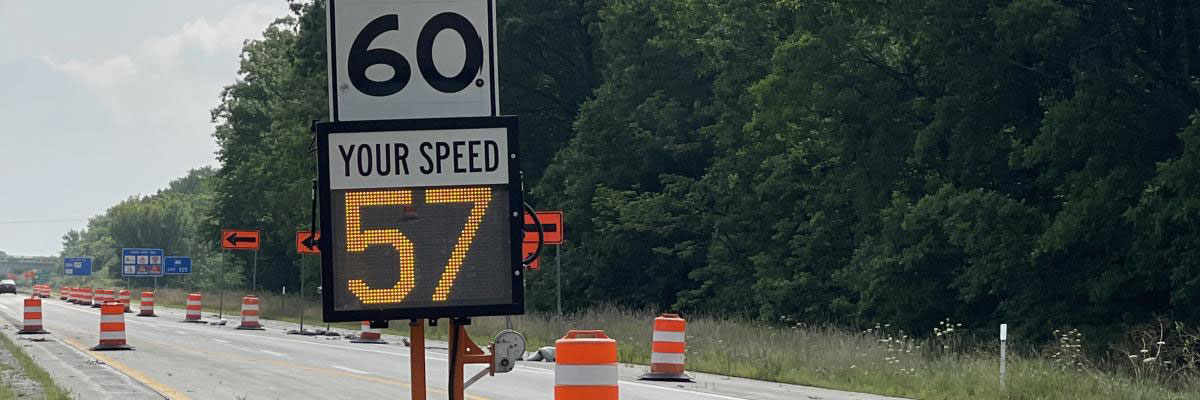
Experts in road safety know that electronic speed feedback signs are helpful in getting drivers to slow down in road construction sites and that can help saves lives. National research recorded 850 fatalities and 42,084 injuries in work zones in 2024.
Research at Michigan State University can now advise road construction crews where to place speed feedback trailers (SFTs) within highway work zones for the greatest effect in reducing vehicle speeds.
That life-saving safety information won MSU the 2026 High Value Research Award from the American Association of State Highway and Transportation Officials (AASHTO). See Improving the Effectiveness of Speed Feedback Trailers in Freeway Work Zones at this research brief.

Professor Tim Gates in the Department of Civil and Environmental Engineering (CEE) said that the effectiveness of speed feedback trailers is highly dependent on their placement within the work zone.
“As with any warning device, placement of the feedback trailer too far upstream of the workers will increase the potential for it to be ignored by drivers, while placement too close to the workers may not give drivers adequate time to make necessary speed adjustments,” Gates said.
“Our research found that placement of the trailer approximately 200 feet upstream of the active work area resulted in the greatest speed reductions at the work area. Multiple feedback trailers should be deployed for work zones that span long distances and/or include multiple active work areas. This includes placement of a trailer on the approach to each area where workers are present, in addition to the start of the lane closure, lane shift, or median crossover.”
Gates noted that combining the feedback signs with police enforcement vehicles enhances the effectiveness of both strategies, leading to greater speed reductions at the work area and lower speeds throughout the work zone.
MSU researchers have been focusing on road construction safety for several years as part of the Smart Work Zone Deployment Initiative (SWZDI). SWZDI is identifying innovative tools and strategies to slow traffic and make work zones safer for all road users. Several states are participating in the collective effort, with research primarily in Michigan.
MSU’s award-winning research will be shared at the AASHTO Research Advisory Committee meeting this summer, with transportation directors at AASHTO executive meetings, and during a poster session at the Transportation Research Board in January 2027.
MSU’s research team was led by Gates and Peter Savolainen, MSU Foundation Professor and CEE department chairperson. Other Spartan students and alumni who participated in the research are Sakar Pahari, Sagar Keshari, Magdalena Cavka, Myles Overall, Sarah Premo, John Racine, Chris Brookes and Sarah Hoffman. Researchers from the University of Missouri were part of the award-winning project.
Written by Patricia Mroczek.
MSU College of Engineering Media and Public Relations page