





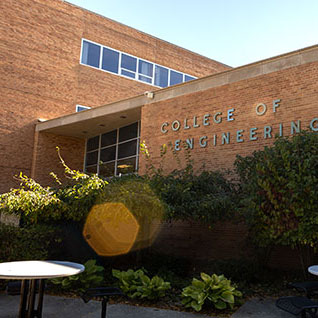
Michigan State University is the nation’s premier land-grant university and one of the top research universities in the world. The College of Engineering is among the university’s founding disciplines and one of the largest academic units. Degrees granted by the college are sought-after and valued in the marketplace, with more than 6,800 students, 341 faculty, and collaborative partners in industry and government working together to deliver the technology talent and innovation needed to drive the economy of Michigan and beyond.
Card Section
Spartan Engineers by the Numbers
Featured News
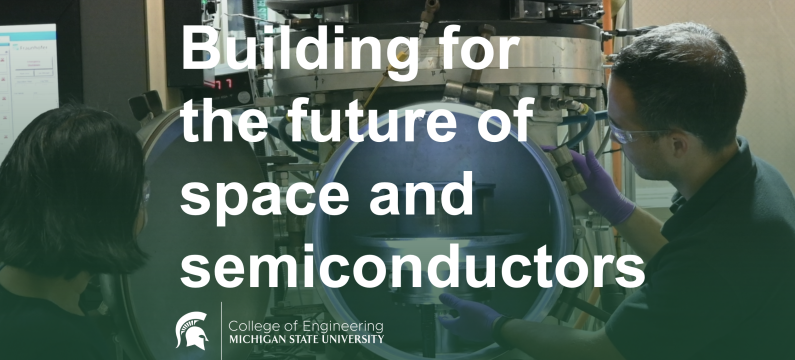
Building for the future of space and semiconductors
Space is a tough place for electronics. High-energy radiation can damage the semiconductor devices that spacecraft rely on, creating a major challenge as missions venture farther from Earth
Read Full ArticleLatest News

MSU launches AI Essentials course for undergrads
Michigan State University is encouraging undergraduates to consider enrolling in a new course to help students understand, evaluate and responsibly use AI.
“AI presents opportunities and challenges across every discipline and in nearly every workplace, and we want to equip our Spartans with dynamic skills for a future-facing economy,” said President Kevin M. Guskiewicz, Ph.D. “Michigan State University’s Green and White Council identified AI readiness as one of its key initiatives, paving the way to make resources available to support faculty in their work to incorporate AI across multiple disciplines, including through the development of a foundational course that helps our students learn how to use AI effectively, efficiently and ethically.”

Biosystems engineering student Grace Gramza named Voyager Scholarship awardee
Michigan State University students Grace Gramza and Anabelle Sanchez have become the institution’s second and third Voyager Scholarship recipients, each securing up to $50,000 in financial aid and a 10-year travel stipend.

13 Engineering faculty honored at 2026 MSU Investiture
Thirteen Michigan State University College of Engineering faculty members were among those honored Sept. 29 during MSU’s 2026 Faculty Investiture and State of the University at the Wharton Center for Performing Arts.


