
Nationally recognized research — from how street design influences driver speeds and safety to turbo roundabouts — put Michigan State University engineers in the spotlight during the 105th Transportation Research Board (TRB) annual meeting in January 2026 in Washington, D.C.
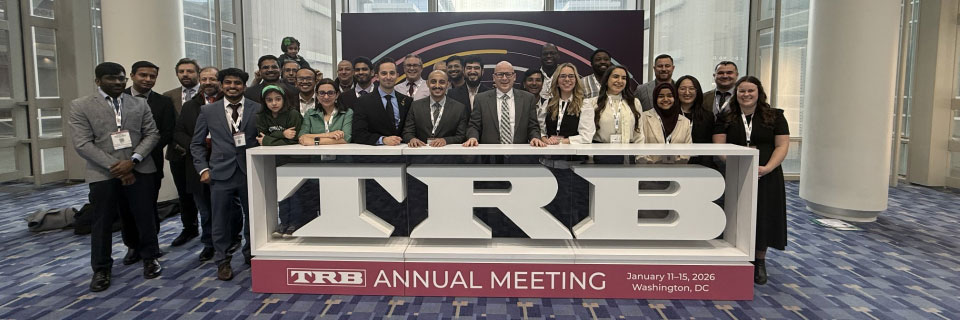
Two MSU-led projects were selected by the American Association of State Highway and Transportation Officials (AASHTO) for its 2026 High Value Research Awards and were highlighted during the State DOT Research: High-Value Project Winners session:
- State DOT Research: High-Value Project Winners, “Complete Streets Speed Impacts,” Peter Savolainen, MSU Research Foundation Distinguished Professor and chairperson of the Department of Civil and Environmental Engineering (CEE), and CEE Professor Timothy Gates.
- State DOT Research: High-Value Project Winners, “Investigating Implementation Potentials of Turbo Roundabouts in Nevada,” Kakan Dey, CEE associate professor, and Md Tanvir Ashraf, CEE doctoral student.
“Our presence at the TRB Annual Meeting reflects the broad expertise at MSU in the transportation and mobility space,” Savolainen said. “We had a total of 49 current faculty, staff, and students participate in the meeting, and a large number of our alumni, as well.”
MSU faculty, staff and students presented nine papers in lectern sessions and 30 papers in poster sessions, sharing research on road weather and winter maintenance, roadway safety and human factors, pavement materials and foundations, public health and the built environment, electric vehicle charging and adoption, automated vehicles, and infrastructure monitoring.
Savolainen also noted, “The quality of our work was reflected by a number of awards… beyond these awards, Spartan engineers are presenting work that is transforming how we design, construct, operate and maintain transportation systems.”
Highlights of MSU participation at the 2026 TRB annual meeting include:
Lectern sessions
- “Development and Validation of a Region-Specific Winter Severity Index for Michigan Based on Maintenance Material Costs,” Ardeshir Fadaei, Farish Jazlan, Ali Zockaie, Mehrnaz Ghamami and James Roath.
- “Planning Charging Infrastructure Network and Fleet Size for Mixed Fleets in Staged Electrification with Budget Constraints,” Nastaran Tork, Behnam Davazdah Emami, Kwangho Baek, Alireza Khani, Sushmita Bhandari and Alyssa Ryan.
- “A Simulation-Based Approach for Optimizing the Placement of Dedicated Lanes for Autonomous Vehicles in Large-Scale Networks,” Ehsan Kamjoo, Alireza Rostami, Fatemeh Fakhrmoosavi and Ali Zockaie.
- “The Impact of Temperature and JPCP Design Features on Surface Roughness and Curvature Using the Finite Element Method,” Hanan Ahmed, Mahdi Masmoudi, Syed Haider, Lev Khazanovich, Christopher Byrum, Hyung Lee and Nizar Lajnef.
- “Development of Asphalt Mixture Uniaxial Cyclic Fatigue Testing Using a Mechanical Clamping System,” Ahmed Hassanien, Michael Elwardany, Poornachandra Vaddy, Muhammed Kutay and Robert Custer.
Poster sessions
- “Effect of Centerlines and Edgelines on Driver Speed Selection and Lane Positioning on Urban Collector Streets,” Akshay Suresh Babu, Sagar Keshari, Sakar Pahari, Vahid Bahrami, Gagan Gupta, Sunday Imosemi, Nischal Gupta, Timothy Gates, Peter Savolainen and Kakan Dey.
- “Professional Drivers’ Perceptions of Automated Vehicles and Willingness to Train for Automated Vehicle Integration: A Latent Profile Analysis,” Shubham Agrawal, Jenna Van Fossen, Amy Schuster, Elizabeth Mack, Shelia Coten and Chu-Hsiang Chang.
- “Application of Deep Neural Network Models for Timeline Monitoring of Bridge Condition Using UAV Datasets,” Surya Sarat Chandra Congress, Mohan Gajapaka, Anand Puppala, Jesse Escamilla III, Bora Cetin and Kristen Cetin.
- “Development of a New Fatigue Failure Criterion Using Optical Flow-Based Multi-Gauge Length Approach,” Poornachandra Vaddy, Muhammed Kutay, Ahmed Hassanien, Michael Elwardany and Robert Custer.
- “The Paradox of Cost Relief and Network Strain: A Distributional Analysis of Progressive Pricing Strategies in Spatially Targeted Electric Vehicle Charging Infrastructure,” Farish Jazlan, Behdad Ghafarnezhad, Alireza Rostami, Erika Rosebrook, Omer Verbas, Ali Zockaie and Mehrnaz Ghamami.
Written by Austin Witt
MSU College of Engineering Media and Public Relations page