MSU researchers pioneer next-generation battery materials and AI diagnostics for industry and public good
Read ArticleThe Michigan Translational Research and Commercialization (MTRAC) Advanced Transportation Innovation Hub, funded by the Michigan Economic Development Corporation (MEDC) and working in partnership with the University of Michigan Electric Vehicle Center, has awarded more than $2 million to support 13 promising mobility research projects across Michigan—including MSU faculty member, Dr. Chengcheng Fang's project, which received funding from both MTRAC and the EV Center, as well as fellow MSU faculty member, Dr. Josh Siegel's project, funded solely by MTRAC.
Automation Alley: Xiaobo Tan Finding Creative Uses for Soft Robots
Read ArticleWhat if a soft robot like Baymax in the Disney animated film Big Hero 6 were real? Xiaobo Tan, MSU Foundation Professor and Richard M. Hong Endowed Chair in the Department of Electrical & Computer Engineering and the Department of Mechanical Engineering, and his team are working to bring that science fiction to life by designing robots made of soft materials that are safer for both human interaction and delicate objects.
Driving innovation: MSU leads the way during Mobility Week
Read ArticleMSU Mobility celebrates Mobility Week, a global initiative focused on innovation at the intersection of transportation and technology, taking place Sept. 20-27, 2025. This initiative brings together mobility and transportation technology experts from around the globe to build partnerships and identify opportunities to accelerate innovation.
Return of space electronics boot camp highlights collaboration
Read ArticleFor a second time, students passionate about the evolving space market had an unparalleled opportunity to learn from experts working on electronics designed to survive the harsh realities of space. And Michigan State University’s Green and White Council stopped in to see the results firsthand.
AI and engineering: Pioneering positive change
Read ArticleA wide range of disciplines are adopting artificial intelligence, or AI, at a rapid pace. From science and medicine to the humanities and education, AI is influencing the landscape of how information is accessed and processed. At Michigan State University, the College of Engineering is exploring new ways for AI to improve lives through railway safety, AI security, learning and health outcomes.
Shiqiang Zou selected Early-Career Research Fellow for Gulf Research Program
Read ArticleShiqiang “Nick” Zou of Michigan State University has been selected for 2025–27 cohort of Early-Career Research Fellows in the Offshore Energy Safety track of the Gulf Research Program (GRP) of the National Academies of Sciences, Engineering, and Medicine (NASEM).
‘Wiggling’ atoms may lead to smaller, more efficient electronics
Read ArticleResearchers at Michigan State University have figured out how to use a fast laser to wiggle atoms in a way that temporarily changes the behavior of their host material. Their novel approach could lead to smaller, faster and more efficient electronics — like smartphones — in the future.
Sweet targets: the quest for an improved whooping cough vaccine
Read ArticleWith cases on the rise, researchers are aiming to develop a “one-two punch” vaccine strategy against pertussis, more commonly known as whooping cough. This work could ultimately help reduce transmission of the disease and combat the threat of resistant bacteria mutating into stronger, more lethal “superbugs.”
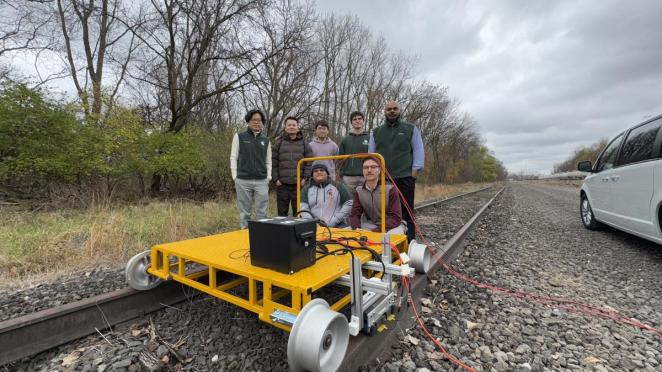
On Track for Innovation: MSU’s Hybrid Rail Inspection System Sets a New Standard for Safety and Speed
Read ArticleAs rail infrastructure across the United States ages under increasing freight demands and higher-speed passenger traffic, the need for smarter, faster, and more reliable inspection methods has never been more urgent. A cross-disciplinary team of Michigan State University (MSU) faculty, postdocs, graduate, and undergraduate students are answering that call with a breakthrough hybrid sensing system that could redefine how railroads detect and prevent failures.
CSE researchers add $1.16 million in new research
Read ArticleThe College of Engineering is among Michigan State University’s top producers of research discoveries and commercialization that help build a diversified economy and generate jobs for Michigan and the Midwest. Three new National Science Foundation (NSF) grants will add $1.16 million in research funding to the Department of Computer Science and Engineering (CSE).

-
-

Our world-class academic team spans eight departments and two interdisciplinary programs
-

Learn about admissions and application processes for our world-class degree programs
-

Our world-class faculty and students engineer a healthier, safer and more sustainable world
-

MSU engineering students maximize early opportunities in the workplace and obtain competitive placements upon graduation
-
-

Sign up to receive the quarterly Spartan Engineering E-News packed with updates within the college