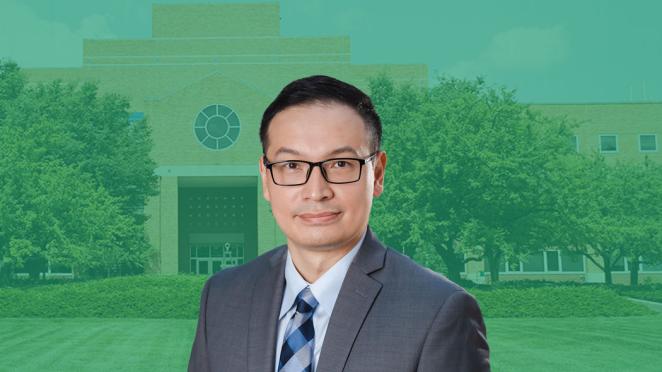
Bill Jin selected for national Early Career Energy Innovation program
Read ArticleA Michigan State University researcher will use $500,000 as part of a federal Advanced Research Projects Agency-Energy (ARPA-E) program to engineer novel ultra-flexible concrete for critical energy infrastructure improvements.
Spalding family gift fuels cross-collaborative innovation
Read ArticleMichigan State University alumnus David F. Spalding, a 1967 mechanical engineering graduate, has made a transformative $10 million leadership gift to accelerate the Leinweber Center for Engineering and Digital Innovation, a facility designed to prepare Spartans to lead at the intersection of technology, creativity and impact.
Leinweber Foundation commits $50M to MSU to name the Leinweber Center for Engineering and Digital Innovation
Read ArticleMichigan State University announced a transformative $50 million commitment from the Leinweber Foundation to establish the Leinweber Center for Engineering and Digital Innovation, a landmark investment that will accelerate MSU’s leadership in education, research and workforce development across Michigan and beyond.
MSU president drives the start of Detroit Auto Show with Pete Buttigieg
Read ArticleWith all eyes and headlights focused on the Detroit Auto Show this week, Michigan State University President Kevin M. Guskiewicz, Ph.D., sat down with former U.S. Secretary of Transportation Pete Buttigieg for a fireside chat about the future of electric vehicle, or EV, research, government partnerships and university research during Media and Industry days.
Mapping soil moisture from space
Read ArticleAgriculture in space? Narendra Das, an associate professor of biosystems engineering in MSU’s College of Engineering, helped build a new tool for space that farms on Earth will benefit from, too.
Research Spotlight: Novel simulations bring new clarity to the Southwest’s water future
Read ArticleAs the American Southwest gets hotter and drier, its dwindling rivers are leaving the region’s vast network of reservoirs struggling to keep up.
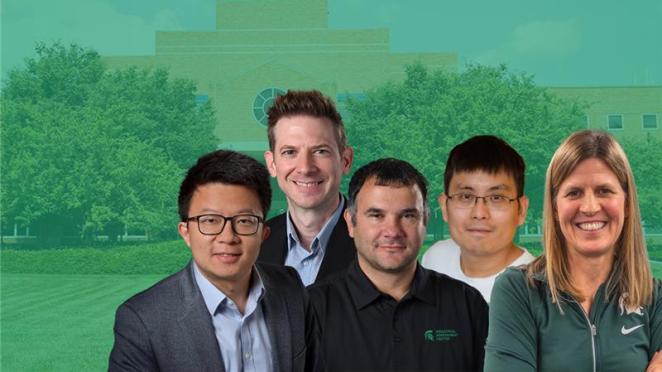
Five Spartan Engineers earn top professor honors
Read ArticleFive from the College of Engineering have received among the highest honors presented to faculty members at Michigan State University. The awards recognize outstanding faculty members for research that enhances MSU’s intellectual prominence nationally and globally.
Research Spotlight: What happens when you cross a worm with a robot?
Read ArticleCorrugated drainage pipes are vital for agricultural operations, but they pose a challenge: it’s difficult to identify problems because they’re underground. To address this, Xiaobo Tan, professor in the Department of Electrical and Computer Engineering at Michigan State University, and his team took inspiration from worms to create robots that easily maneuver through the pipes.
Research Spotlight: Powering tomorrow’s batteries with today’s breakthroughs
Read ArticleFrom fueling electric vehicles to stabilizing renewable grids, the world’s demand for safe, high-capacity energy storage keeps rising. Ruigang Wang in the Department of Chemical Engineering and Materials Science at Michigan State University is tackling that challenge by rethinking how batteries themselves are built.
Research Spotlight: A solution to end unplanned downtime
Read ArticleWhat if we could embed expert-level intelligence into devices like smartphones, enabling built-in microphones to “see under the hood” of complex systems?

-
-

Our world-class academic team spans eight departments and two interdisciplinary programs
-

Learn about admissions and application processes for our world-class degree programs
-

Our world-class faculty and students engineer a healthier, safer and more sustainable world
-

MSU engineering students maximize early opportunities in the workplace and obtain competitive placements upon graduation
-
-

Sign up to receive the quarterly Spartan Engineering E-News packed with updates within the college