


The plaque that builds up on your teeth and the slippery coating on rocks in a stream have something in common: they’re both examples of biofilms, communities of microorganisms that attach to surfaces and surround themselves with a protective layer. Biofilms are common in nature, and they can become a serious problem when they form inside the human body. In the lungs, for example, bacteria growing in biofilms can be particularly difficult to treat because their protective surroundings help them resist antibiotics. Knowing whether bacteria have formed a biofilm could provide doctors with valuable information about an infection but, currently, there is no noninvasive way of determining whether these communities are present inside the lungs.
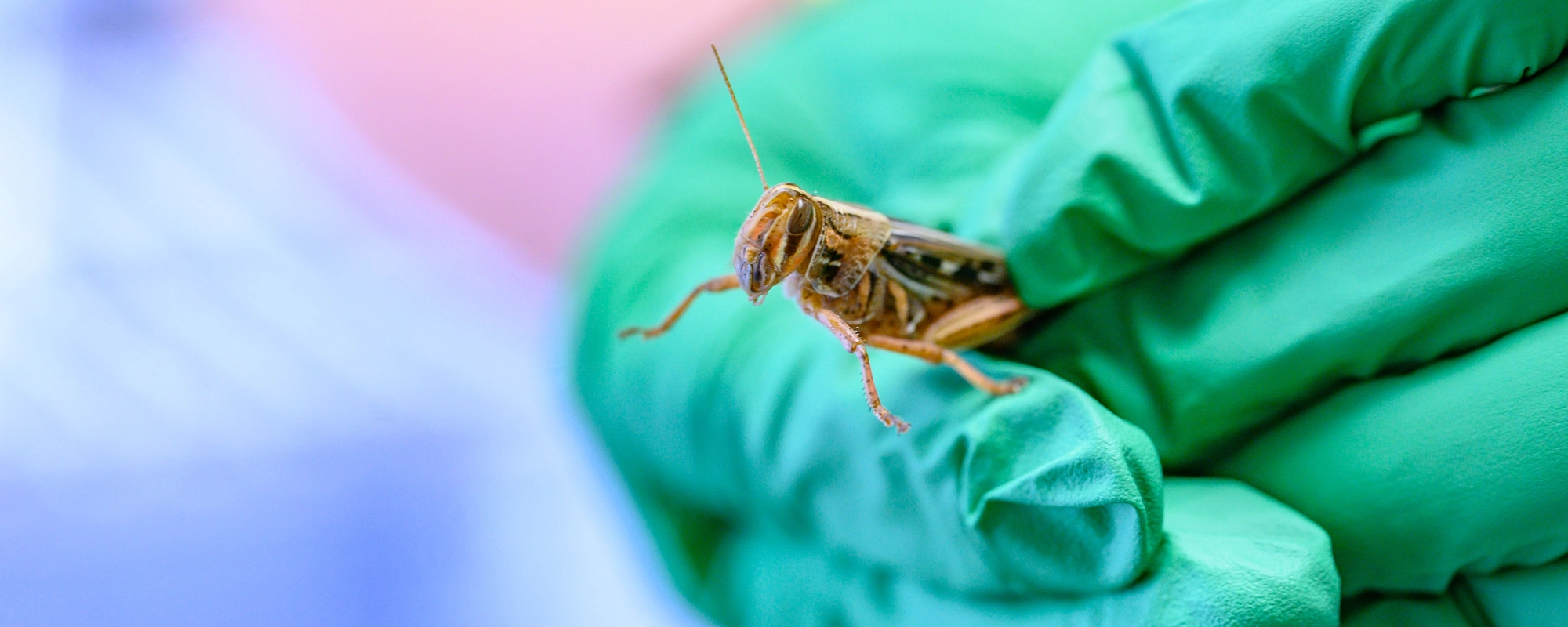
Researchers at Michigan State University are exploring an unusual way to detect them: locusts.
The insects have a remarkably sensitive sense of smell, and MSU researchers wanted to know if they could distinguish between bacteria growing in biofilms and those growing freely.
In a new study published in Communications Biology, a team led by first author Michael Parnas and senior authors Jonathan Hardy and Debajit Saha in MSU's Institute for Quantitative Health Science and Engineering, or IQ, found that they could. The research brought together expertise in microbiology and biological sensing from across MSU, opening a potential new avenue for detecting biofilms associated with difficult-to-treat infections.
Finding information in bacterial odors
Bacteria release volatile organic compounds, or VOCs, as they grow and metabolize nutrients. These chemicals form complex mixtures that can vary depending on the bacteria producing them and the conditions in which they are growing.

For Saha, an associate professor in MSU’s College of Engineering, earlier research offered a promising starting point. He and his colleagues had previously demonstrated that the locust olfactory system could distinguish chemical signatures associated with human oral and lung cancer cells.
To investigate this latest question, the researchers compared two bacterial species, Pseudomonas aeruginosa and Staphylococcus aureus, growing in solid biofilms and in planktonic cultures like plankton, where bacteria exist as free-floating cells. The goal was to determine whether the locust olfactory system could recognize differences between the two growth states within each species.
“What we did not know was whether the odor produced by bacteria would contain enough information to reveal something as specific as their growth state — whether the bacteria were organized on a biofilm surface or growing planktonically,” Saha said. “Seeing such a high level of discrimination was therefore quite surprising.”
Reading smell directly from the brain
Rather than training locusts to respond to particular odors, the researchers recorded how their brains processed them. Locusts do not have noses; they use their antennae to smell. By placing electrodes in a region of the brain called the antennal lobe, the team could measure the electrical activity generated as the insects encountered odors from the bacterial cultures.

“It’s amazing that wires in the brain of a locust can tell whether it is smelling something,” said Hardy, associate professor in MSU’s Department of Microbiology, Genetics and Immunology and IQ. “The electrical patterns are incredibly complex, but the firing of individual nerve cells can be picked out of the pattern.”
The approach takes advantage of the insect olfactory system’s ability to recognize complicated mixtures of chemicals. Instead of identifying individual VOCs, the locust brain processes the mixture and produces a characteristic pattern of neural activity that researchers can analyze
“The insect brain performs the complex odor processing, while our electronics and algorithms translate that neural activity into an identifiable signal,” Saha said.
The neural patterns revealed clear differences between the bacterial growth states. By analyzing responses across populations of neurons, the researchers could classify biofilm and planktonic samples with up to 96% accuracy.
“The result suggests that bacterial odors contain much richer biological information than simply indicating the presence or absence of bacteria,” Saha said. “Changes in bacterial physiology and growth state can alter the complex mixture of VOCs released into the environment, and the insect olfactory system appears to be able to detect and distinguish these subtle changes.”
Saha likens these odors to chemical fingerprints that reflect the bacteria’s biological state.
The neural response was also remarkably fast. An odor exposure of approximately half a second generated activity that could be used to distinguish the samples, with the researchers identifying highly discriminatory responses within the first couple of seconds. Their analysis required less than five seconds of neural data, suggesting that the approach could eventually support near-real-time chemical detection.
From bacterial cultures to human breath
The findings establish that the locust olfactory system can distinguish bacterial growth states under controlled laboratory conditions. Whether it can detect the same signatures in human breath, however, remains an important unanswered question.
Breath contains thousands of volatile compounds influenced by factors such as diet, medications and environmental exposures. Researchers will need to determine whether signals associated with bacterial biofilms can be reliably separated from this complex chemical background.
Hardy said the team is interested in testing breath samples from children with cystic fibrosis, who can develop persistent lung infections involving bacterial biofilms. If successful, the approach could eventually provide a noninvasive way to obtain information about an infection without directly sampling bacteria from the lungs.
Additional research will be needed before that possibility can be evaluated clinically. The team must test more bacterial species and clinical samples, determine whether neural signatures remain consistent across different conditions, and compare the results with established microbiological and clinical methods.
Saha’s longer-term goal is to develop a portable, real-time biosensor that combines a living insect’s olfactory system with miniaturized electronics and artificial intelligence. In this proposed system, the locust brain would detect and process complex chemical mixtures, while electronic components would record the neural activity and machine-learning algorithms would interpret the results.
“What makes this direction particularly exciting is the possibility of bringing together biology and engineering,” Saha said. “Instead of trying to reproduce the enormous complexity of an insect’s olfactory system entirely with artificial sensors, we can potentially harness the biological system itself and connect it to modern electronics and machine learning. That could open a new approach to rapid, noninvasive chemical detection.”
This research was supported by grants from the National Science Foundation.
Story courtesy of MSUToday.
MSU College of Engineering Media and Public Relations page