
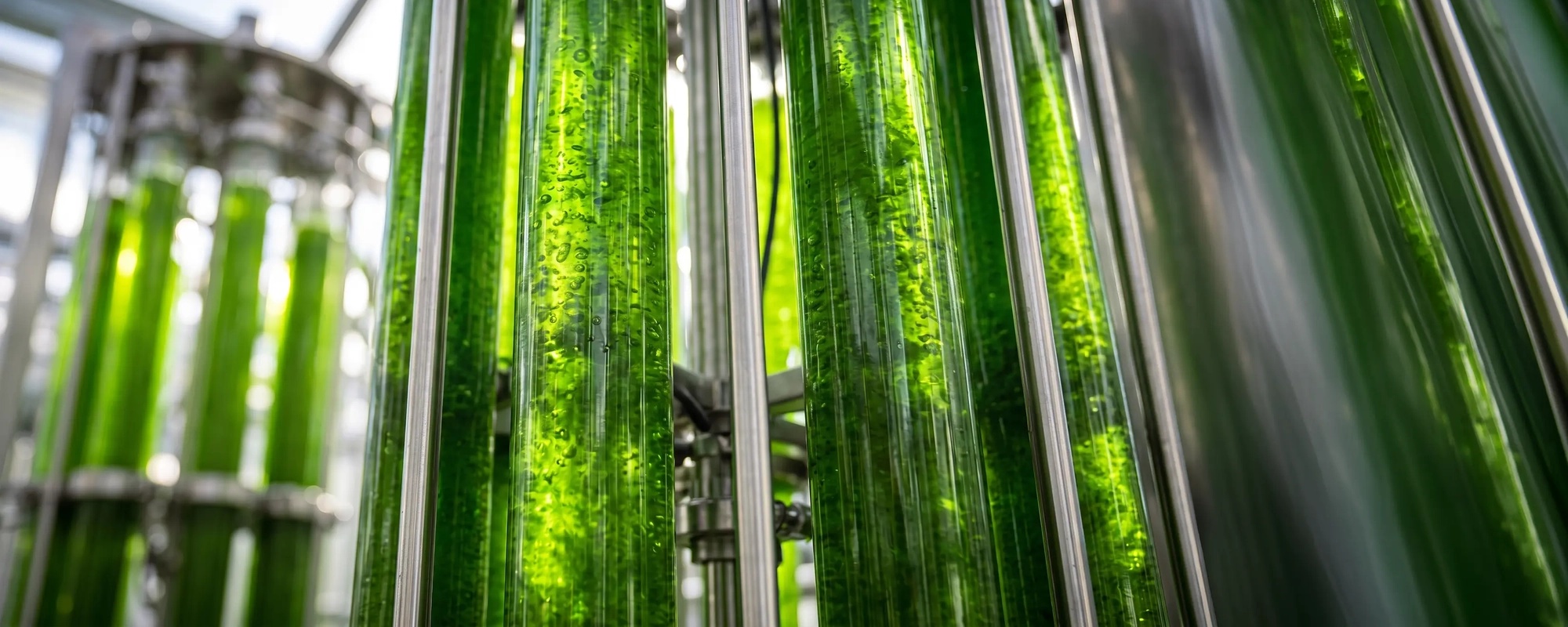
Algae are increasingly being explored as sustainable “living factories” that can convert sunlight and carbon dioxide into renewable fuels, plastics, pharmaceuticals and other valuable products.
Now, researchers at Michigan State University have developed a fiber-optic-inspired technology that distributes sunlight more evenly throughout algae cultivation systems, increasing biomass productivity by as much as six times in outdoor testing.
The researchers believe the technology could benefit a wide range of applications that rely on photosynthetic organisms, including biofuel production, carbon capture and sustainable manufacturing.
One longstanding challenge in algae farming has been getting enough sunlight to all the algae inside a cultivation system. As algae grow, cells near the surface absorb much of the available light, leaving cells deeper in the system with too little light to photosynthesize efficiently.
“Photosynthesis is incredibly powerful, but one of its biggest limitations is that light is not distributed evenly,” said Yijie Cheng, a doctoral student in MSU's College of Engineering and the lead author of the paper. “Some organisms receive too much light while others receive too little. Our technology helps deliver light where it’s needed.”
To solve the problem, the research team created flexible hydrogel optical fibers embedded with silica nanoparticles that are about 2.5 millimeters in diameter, or as thick as a typical plastic drinking straw. Rather than delivering sunlight to a single point, the fibers scatter light along their entire length, creating more uniform illumination throughout the cultivation system.
In outdoor testing under natural sunlight, the fibers significantly increased photosynthetic efficiency and boosted biomass productivity by as much as six times compared with conventional cultivation systems.
“This work demonstrates that we don’t necessarily need more light or more electricity to increase productivity,” said Xinyue Liu, assistant professor in the Department of Chemical Engineering and Materials Science and a co-author on the paper. "We simply need to use the sunlight we already have more effectively.”
Previous approaches often relied on high-powered LED lighting systems that require substantial amounts of electricity. By contrast, the new system improves photosynthesis through passive light management, redistributing existing sunlight without additional energy demands.
More efficient algae cultivation could help lower the energy required to manufacture renewable products while improving systems designed to remove carbon dioxide from the atmosphere.
Looking ahead, the team believes the same concept could help overcome light penetration limits in other solar-driven biological and chemical systems.
“Nature already provides an abundant source of solar energy,” said Cheng. “Our goal is to use it more efficiently by delivering sunlight where it is needed most.”
The research was published in the Proceedings of the National Academy of Sciences.
Story courtesy of MSUToday.
MSU College of Engineering Media and Public Relations page