
Roughly 6 million patients go to the emergency department each year with skin and soft tissue infections, yet their medical evaluation is based on centuries-old guidelines: the “four cardinal signs” of inflammation — redness, heat, swelling and pain.
There is no diagnostic tool to help medical professionals determine which conditions require hospitalization for intravenous antibiotics and which can be treated with medicine at home, so treatment becomes a subjective decision, according to Joshua Reynolds, an emergency medicine physician and associate professor at the Michigan State University College of Human Medicine.
“Throughout the history of medicine, we’ve relied on clinicians recognizing these four signs of inflammation, but physical diagnosis is hampered by variations in skin color and other underlying conditions,” Reynolds said. “Because doctors would rather err on the side of caution, we see a startling number of over-diagnoses.”
The stakes are high. In the U.S. alone, skin and soft tissue infections cost the healthcare system upward of $15 billion annually. Research shows that as many as 30% to 50% of hospitalized patients may be incorrectly diagnosed.
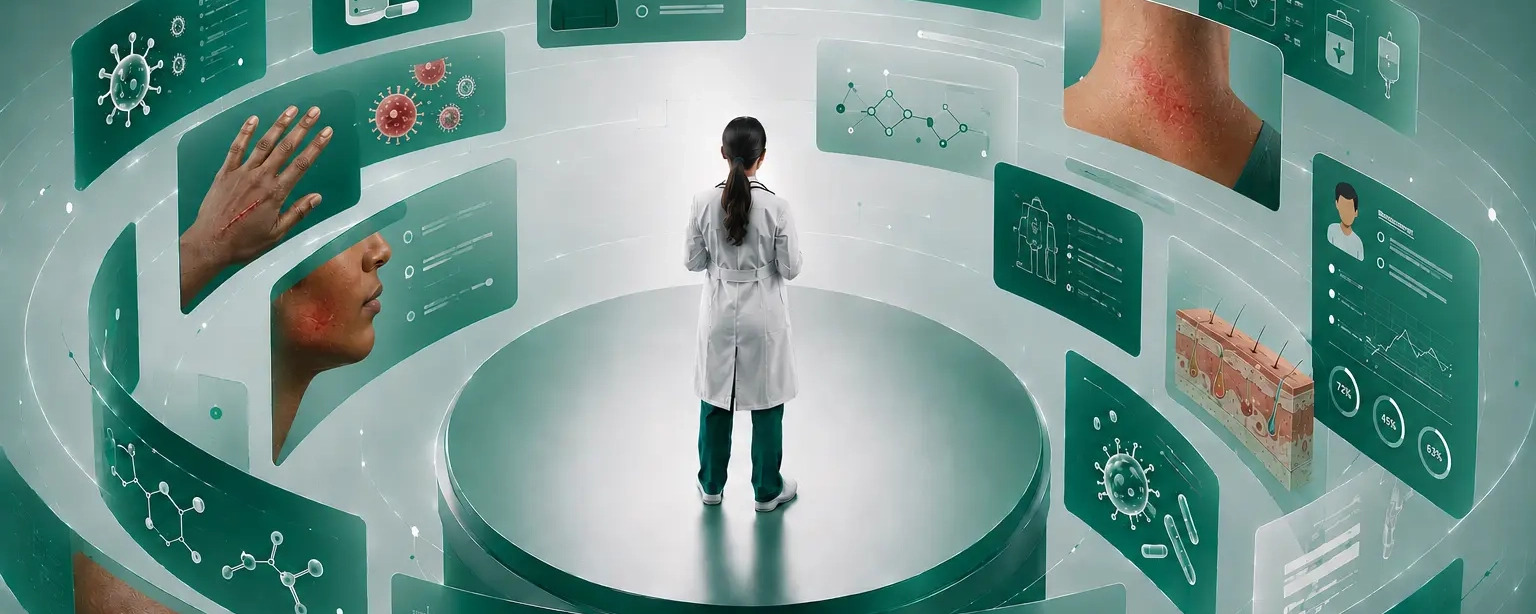
To solve this, Michigan State University researchers have launched a $1 million project funded by the National Science Foundation and the National Institutes of Health. The goal is to develop a multifunctional artificial intelligence, or AI, model to offer a second opinion using high-definition video and thermal imaging to see what the human eye cannot.
While the medical goal is clear, the technical challenge is more complex due to AI bias. If a model is trained primarily on one group of people, its accuracy can drop when treating others. Vishnu Boddeti, an associate professor of computer science at the MSU College of Engineering, is tasked with solving this mathematical hurdle. The resulting solutions will be applicable to a wide range of high-stakes initiatives in fields like education, finance and law.
“Every day, these AI models impress us, but we’re still not sure how trustworthy and reliable they are,” Boddeti said. “This project has two AI-related objectives: to deal with the AI bias and preserve the privacy of patient data.”
This new AI model isn’t just being built in a lab on the MSU campus — it’s being trained through massive data partnerships with two of Michigan’s leading health systems. Through the Corewell Health-MSU Alliance Corporation, the research team has built a specialized HIPAA-compliant infrastructure to securely transfer and house thousands of clinical data points and visual images. This partnership provided the initial clinical data set essential for proving that the AI could work in a real-world hospital setting.
To ensure the AI works for everyone, the team expanded its reach through the Henry Ford Health + Michigan State University Health Sciences partnership. This collaboration allows researchers to access a much more racially and ethnically diverse group of patients.
“One of the things we are most interested in is if you train a model on people with one skin color, will it still perform as well on others?” Reynolds said. “Partnering with Henry Ford Health gives us the heterogeneity we need to make sure this tool is reliable for all patients.”
This new AI could also help patients track their own recovery progress. Research shows that about 10% ofdischarged patients return to the emergency room within three days simply because they aren’t sure if they are healing properly.
“Patients and families tend toward hyper-vigilance,” Reynolds said. “Very few of these return visits actually require a change in treatment. We want to relieve concerns by showing them if the infection is healing like it should.”
This work was initiated with a $30,000 seed grant from the MSU Tetrad Initiative, which encourages researchers from different fields — like emergency medicine and computer science — to work together for the first time.
“That startup money let us form the team and create the infrastructure,” Reynolds said. “It gave us the opportunity to spend time thinking about this problem.”
That early thinking has grown into a widespread effort to provide a future of more objective, accurate and equitable care for everyone. Once the model is fully functional and reliable with no bias, the team plans to extend this solution to an app that patients could use at home to monitor healing.
MSU College of Engineering Media and Public Relations page