
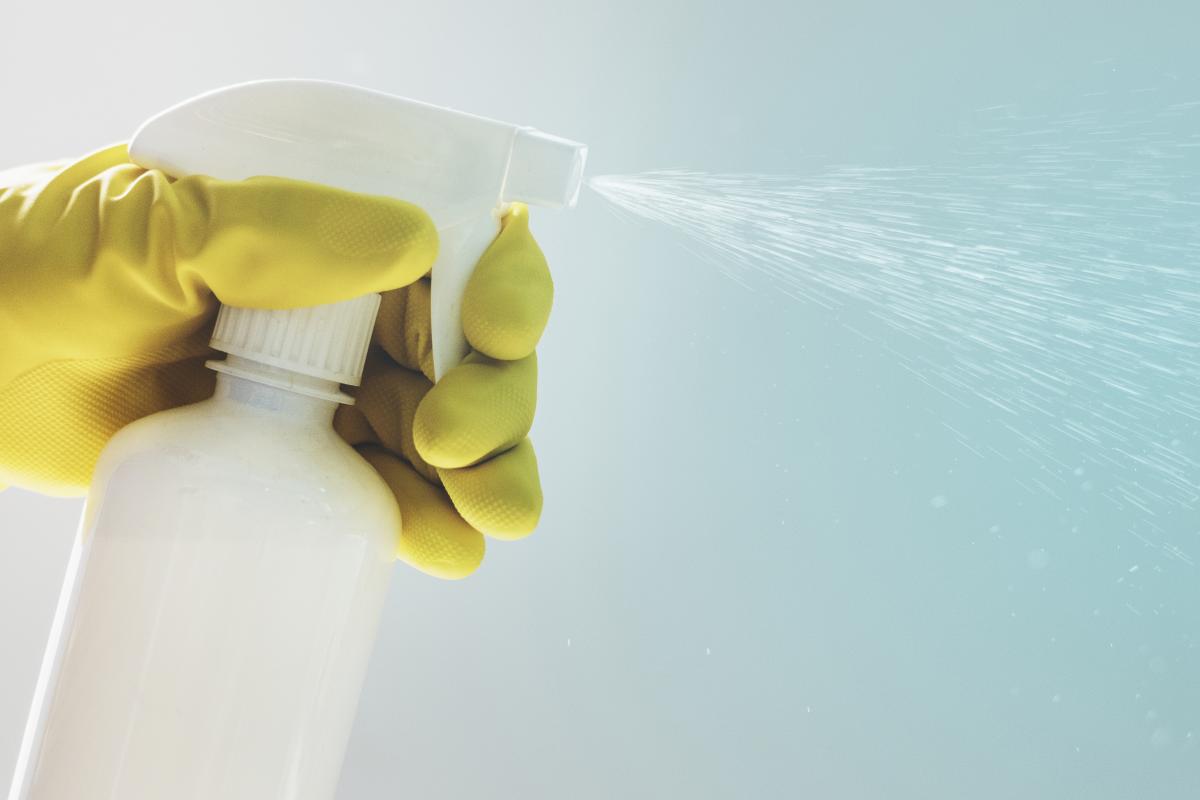
Every time you spray disinfectant or wipe down surfaces with cleaning products, it releases chemicals called volatile organic compounds (VOCs) into the indoor environments. Kaisen Lin and his team in the Department of Civil and Environmental Engineering at Michigan State are studying what happens when these invisible chemicals mix with viruses floating in the air around us.
In their laboratory, researchers create tiny virus-laden droplets similar to what you exhale when you cough or sneeze. They then expose these droplets to cleaning product chemicals and track how the particles size and viruses infectivity evolve over time.

The team also uses computer models to predict where these altered particles land in your respiratory system when you breathe them in.
The research addresses a surprising possibility: cleaning products intended to protect us may actually alter how viruses behave in the air. Certain chemicals may increase the persistence of airborne viruses and enable them to travel deeper into your lungs, while others may inactivate viruses and therefore reduce the risk of infection.
The findings will provide scientific evidence to support safer cleaning practices at home, work, and school. This research is particularly important for communities with limited healthcare access who rely heavily on cleaning products for protection. By understanding how our cleaning habits affect the air we breathe, Lin’s team is pursuing better indoor air quality for everyone.
Discover more about Lin’s research:
- Humidity-Dependent Decay of Viruses, but Not Bacteria, in Aerosols and Droplets Follows Disinfection Kinetics [Article]
- Influenza Virus Infectivity Is Retained in Aerosols and Droplets Independent of Relative Humidity [Article]
- Survival of MS2 and Φ6 viruses in droplets as a function of relative humidity, pH, and salt, protein, and surfactant concentrations [Article]
- Research Lab [Website]
- Google Scholar [Website]
MSU College of Engineering Media and Public Relations page