
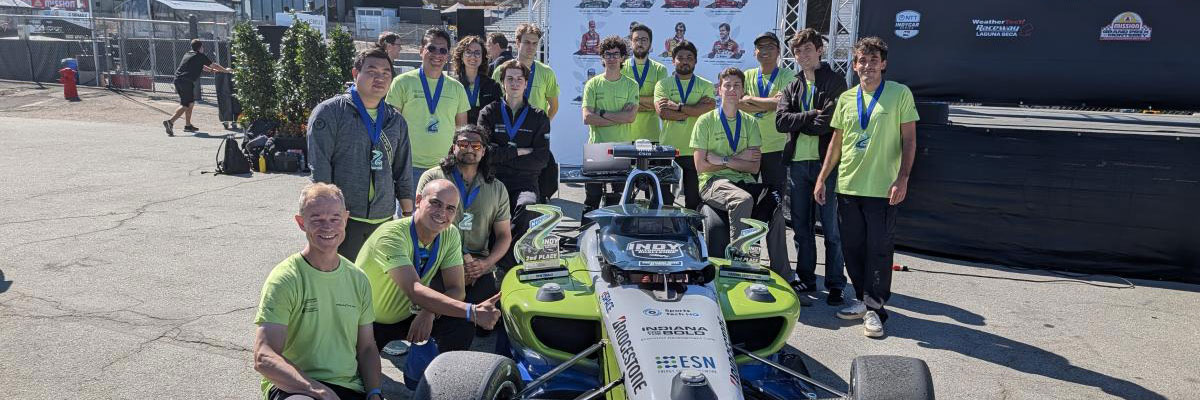
At WeatherTech Raceway Laguna Seca in Monterey, California, the challenge was no longer just racing the clock.
On Sept. 3, autonomous racecars also had to perceive, predict and pass one another on the technically demanding road course without a human behind the wheel.
Michigan State University engineers contributed to two PoliMOVE-TEC podium finishes at the Indy Autonomous Challenge. The international team finished second in the IAC Time Trial and third in the Passing Competition.
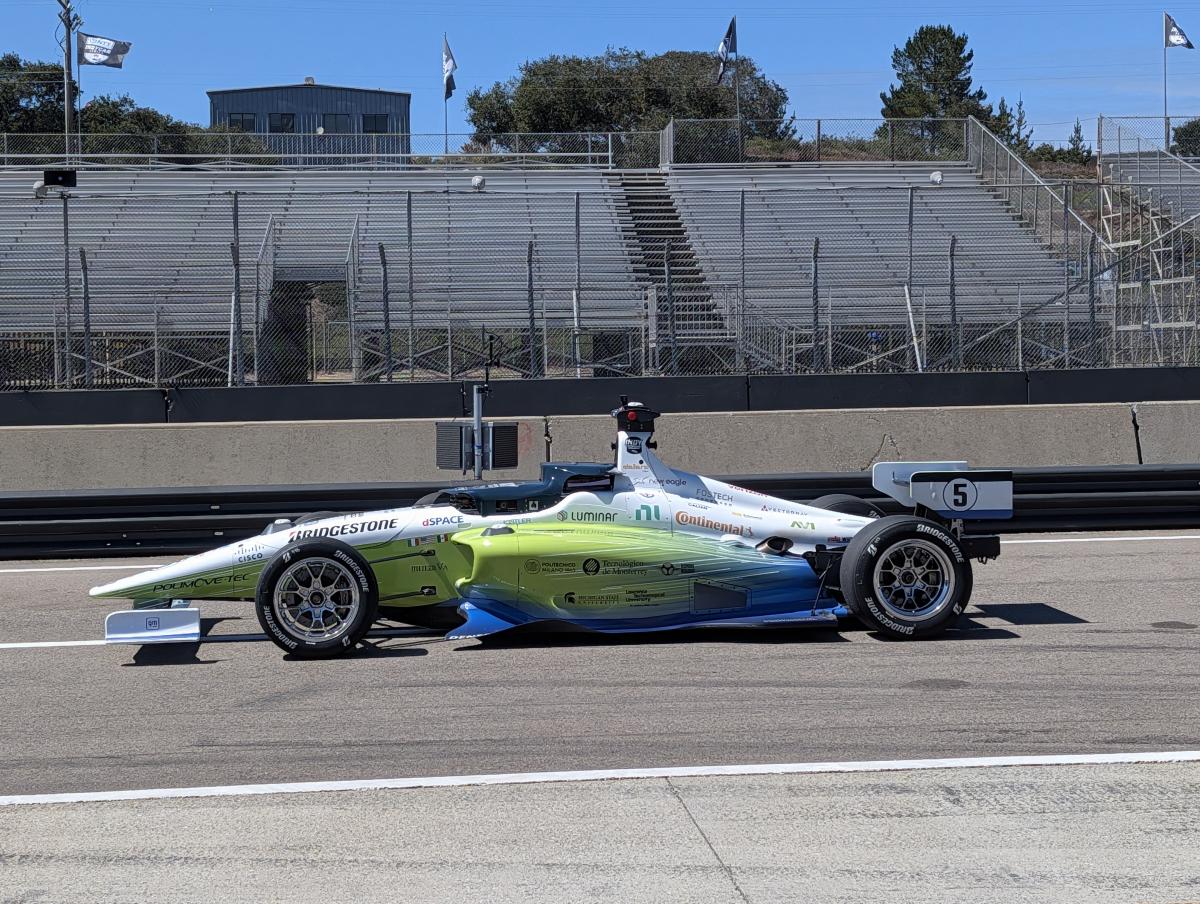
Laguna Seca at a glance
- Second place, Time Trial: PoliMOVE-TEC completed its fastest lap in 1 minute, 28.132 seconds.
- Third place, Passing Competition: PoliMOVE-TEC advanced to the third-place matchup after a head-to-head race with UNIMORE Racing, then completed an autonomous overtake of KAIST, the Korea Advanced Institute of Science and Technology, into the Turn 2 Andretti Hairpin to finish third.
- Technical milestone: The event marked the first time IAC adapted its autonomous passing competition to a road course.
A tougher test for autonomous racing
The Indy Autonomous Challenge provides teams with its Dallara-built AV-24 autonomous racecars, while university research teams develop the artificial intelligence, or AI, driver software that controls them. The cars use numerous sensors including lidar, radar, global navigation satellite systems, or GNSS, and optical cameras as they navigate without human drivers.
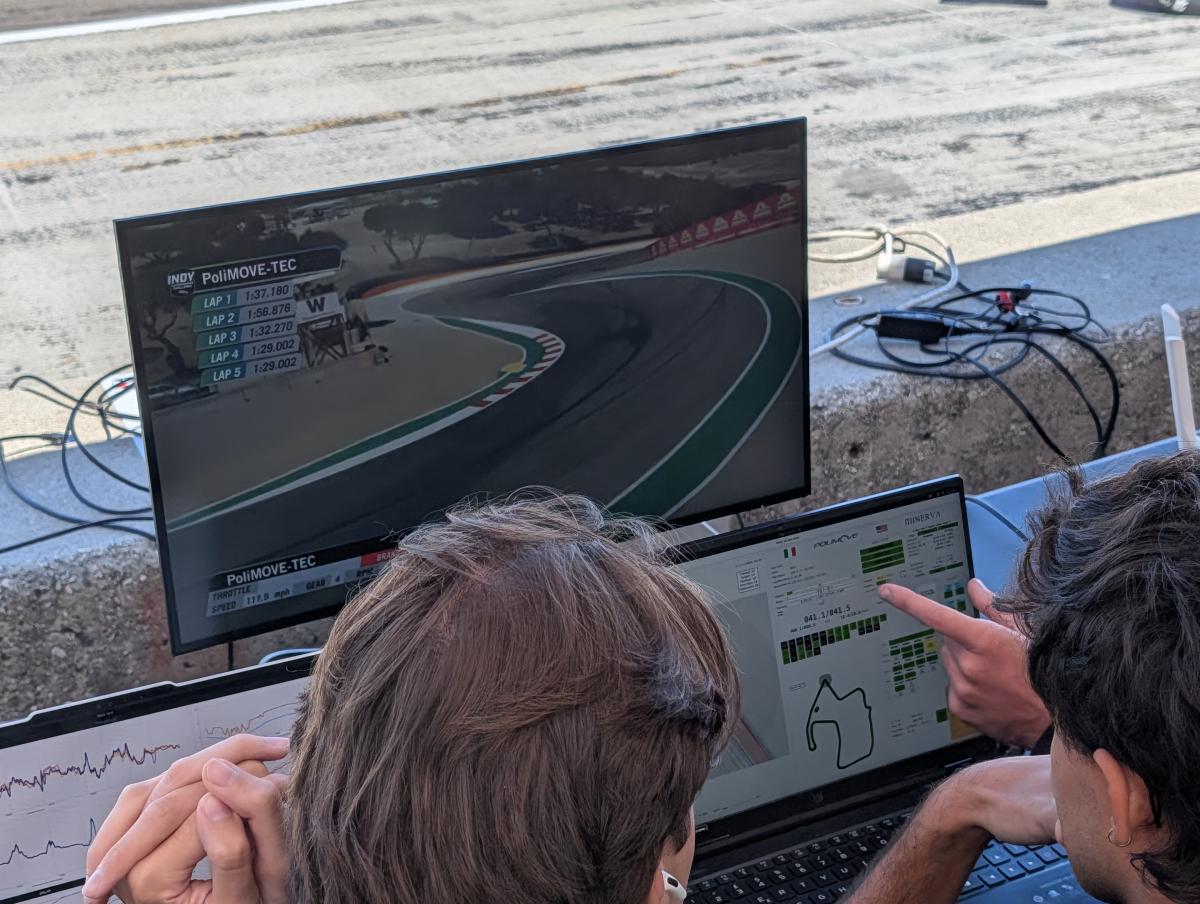
Laguna Seca added another level of difficulty.
Previous IAC passing competitions had taken place on oval tracks. On a road course, AI drivers must account for changing corner geometries, braking zones, limited sightlines and rapid elevation changes while also anticipating and responding to another autonomous racecar. “This was the first time ever that the IAC did the passing competition on a road course,” said Judd Herzer, director of mobility research and innovation at MSU. “All previous passing competitions took place on oval tracks. This was an added level of difficulty, and on a particularly challenging road course to boot.”
The results also offered a year-over-year measure of the technology’s progress. PoliMOVE-TEC completed the Time Trial in 1:28.132, improving on the 1:29.792 benchmark set by PoliMOVE-MSU at Laguna Seca in 2025. The Passing Competition added another layer of complexity. After advancing to the semifinals, PoliMOVE-TEC completed an autonomous overtake of KAIST entering the Andretti Hairpin in the third-place matchup.
Across the competition, IAC reported five successful high-speed overtakes, no hardware failures and no collisions involving the AV-24 racecars.
Engineering under real-world constraints
MSU contributors to the autonomous racing effort include Daniel Morris, associate professor in Biosystems and Agricultural Engineering and Electrical and Computer Engineering; Josh Siegel, associate professor in Computer Science and Engineering and Electrical and Computer Engineering; Shaunak Bopardikar, associate professor in Electrical and Computer Engineering; and Herzer. MSU students involved in the 2026 effort include Hafez Irshaid, a Computer Science and Engineering doctoral student who developed a new 3D vision system; Nicholas Lindberg, an undergraduate student who helped optimize the system; and Adam Atoom, president of the Spartan Autonomous Racing Club, or SpARC, for the 2026-27 academic year, who is leading a new simulation competition at MSU.
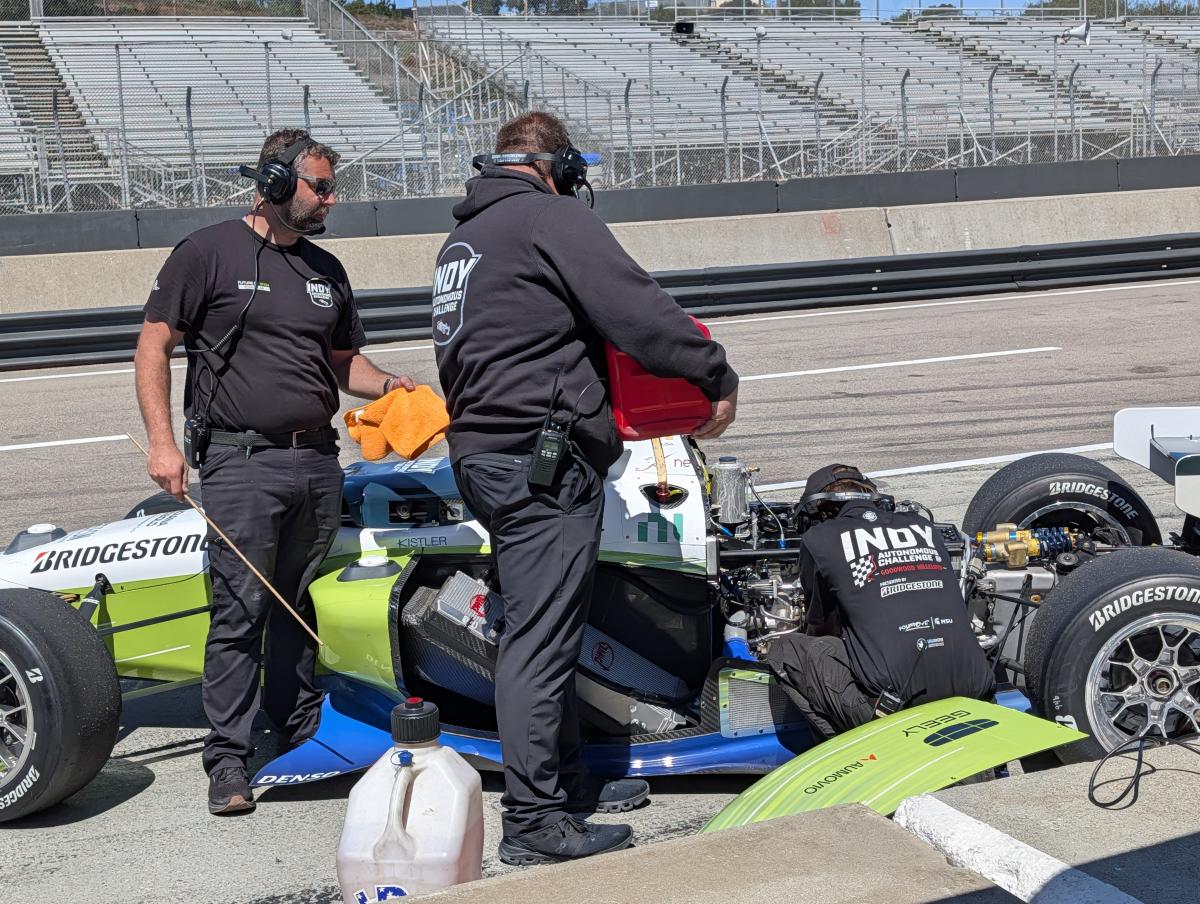
The new camera-based system is designed to detect opposing vehicles and determine their locations at distances beyond the range of the racecar’s lidar. Morris said the MSU system achieves close to state-of-the-art performance using about one-tenth of the computation, an important consideration for software that must operate in real time.
The vision system was not deployed during the Laguna Seca competition because of limitations in the racecar’s current computing system. The team instead relied on lidar and radar. With an anticipated in-car computing upgrade in 2027, Morris said the team plans to deploy the vision system in future competition. “Racing at Laguna Seca forces our autonomous software to make split-second decisions through sharp turns and blind corners, exactly the kind of challenge that turns classroom knowledge into real engineering skill,” Morris said.
Before software reaches the physical racecar, students also can test ideas through high-fidelity simulation. This year, Atoom is leading a new MSU simulation competition that challenges students to push the performance of the autonomous racing software. Morris said simulation gives students room to experiment without putting physical hardware at risk.
A new Michigan connection
The 2026 season also marks a new chapter for MSU’s autonomous racing effort.
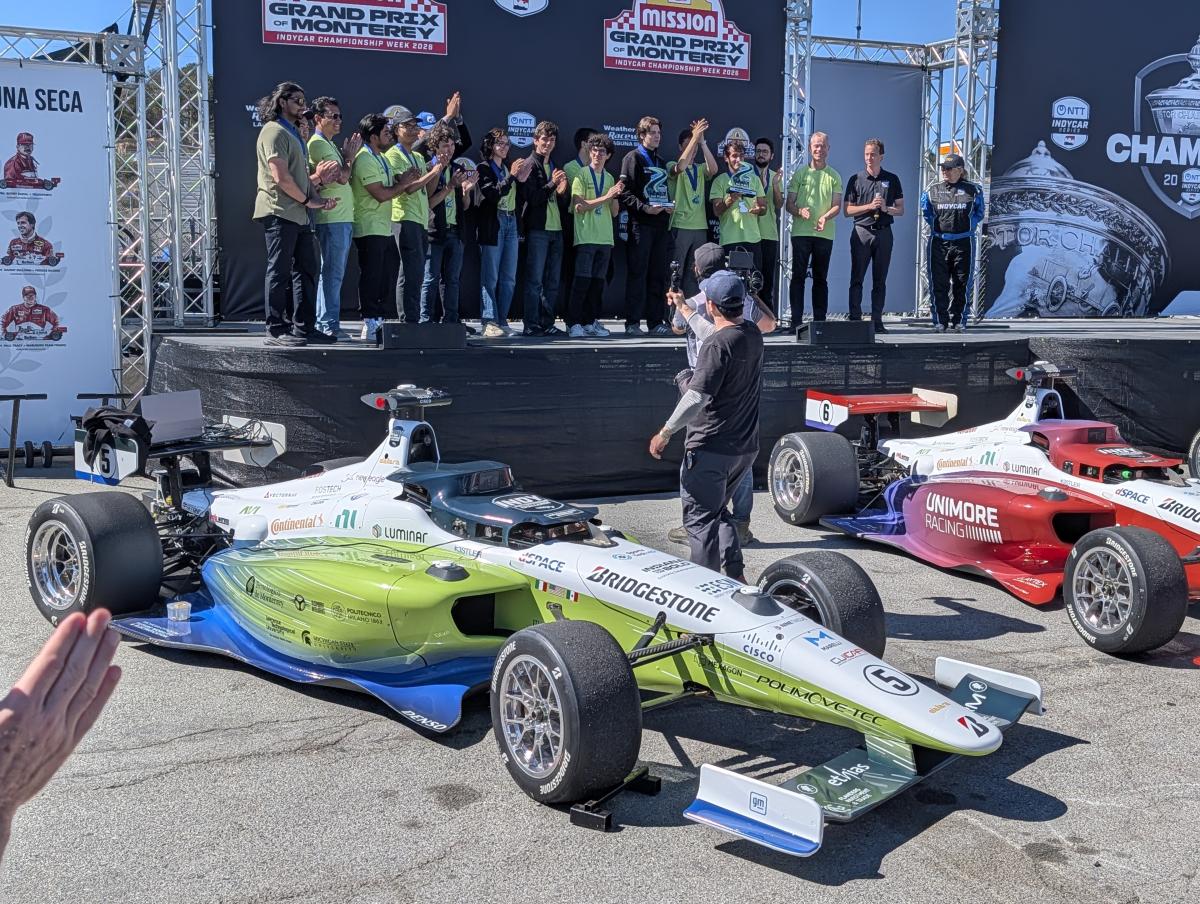
Lawrence Technological University joined the collaboration this year, adding another Michigan institution to an international team spanning three countries. PoliMOVE-TEC includes Politecnico di Milano in Italy, and Tecnológico de Monterrey in Mexico, working in cooperation with Michigan State and Lawrence Tech.
According to Herzer, Politecnico di Milano leads the broader racing effort, while software development is collaborative across the institutions. MSU and Lawrence Tech have contributed primarily to perception and localization, though Herzer noted that the work is not divided into rigid university assignments.
Perception allows the AI driver to detect and track objects around the racecar. Localization helps it determine where it is on the track and its position relative to its surroundings. Those capabilities work alongside dynamics and control systems responsible for functions including speed, braking, turning and decision-making.
The expanded collaboration also creates opportunities beyond race results. Working across universities gives Spartan Engineers experience collaborating internationally and solving complex engineering problems across geographic, cultural and institutional boundaries.
“Competing at this level gives our students an experience that simply can’t be replicated in a classroom,” Herzer said. “They’re working alongside world-class engineers, solving complex problems under real race conditions, and seeing firsthand what it takes to push autonomous vehicle technology to its limits.”
That combination of research, hands-on learning and cross-institutional teamwork is central to MSU’s involvement in autonomous racing. It gives Spartan Engineers opportunities to test new ideas under demanding conditions while developing skills that extend well beyond motorsports.
“From here, our focus is on building on what we’ve learned, creating even more opportunities for MSU students to contribute, and continuing to push the boundaries of what autonomous vehicles can do,” Herzer said.
The team’s 2026 effort is supported by DENSO and the Michigan Office of Future Mobility and Electrification.
Learn more about MSU Mobility and revisit MSU Engineering’s 2025 Laguna Seca coverage.
Written by Austin J. Witt
MSU College of Engineering Media and Public Relations page