





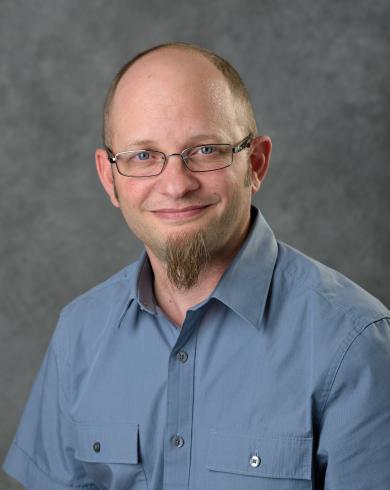
Michael James
Contact Information
Phone:
Email:
Research Assistant III
Biography
Facility manager of all research activities in the MSU BSL-2 Pilot Processing Facility. Mainly, management involves developing and implementing pilot-scale food safety interventions for reducing pathogens, such as Salmonella and Listeria, using various food processing technologies. Recent projects have consisted of food products such as: almonds, dates, wheat flour and kernels, celery, strawberries, lettuce, spinach, beef, poultry, and pork. Also, different food processing technologies are utilized such as: moist and dry-heating ovens, ozone, irradiation, chlorine dioxide, chemical sanitization, and water activity modification.
Selected Publications
- Smith, D. F., and Marks, B. P. 2015. Effect of Rapid Product Desiccation or Hydration on Thermal Resistance of Salmonella enterica Serovar Enteritidis PT 30 in Wheat Flour. Journal of Food Protection, 78(2), 281-286.
- Arango, J., M. I. Rubino, R. Auras, A. A. Rachford, Z. Bai, A. L. Grzesiak, and T. Kijchavengkul. 2014. In situ quantification of chlorine dioxide gas consumption by fresh produce using UV–visible spectroscopy. Journal of Food Engineering, 131, 75-81.
- Moosekian, S. R., S. Jeong, E. T. Ryser. 2014. Inactivation of sanitizer-injured Escherichia coli O157:H7 on baby spinach using X-ray irradiation. Food Control. 36(1), 243-247.
- Aleid, S. M., K. Dolan, M. Siddiq, S. Jeong, and B. Marks. 2013. Effect of low-energy X-ray irradiation on physical, chemical, textural and sensory properties of dates. International Journal of Food Science and Technology. 48(7), 1453-1459.
- Jeong, S., B. P. Marks, E. T. Ryser, and J. B. Harte. 2012. The effect of x-ray irradiation on Salmonella inactivation and sensory quality of almonds and walnuts as a function of water activity. International Journal of Food Microbiology. 153(3), 365-371.
News

MSU Engineering honors 16 for dedicated service
Five staff members retired from the Michigan State University College of Engineering in 2023. Additionally, 11 others have been honored for many years of service tos Michigan State. Engineering Dean Leo Kempel thanked each Spartan Engineer for their contributions and dedication.