
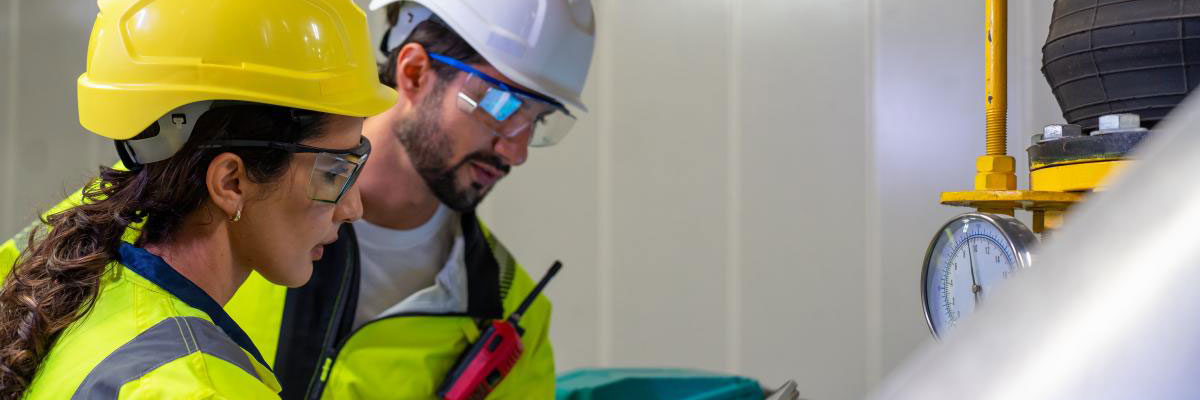
At first glance, the MSU Industrial Training and Assessment Center (ITAC) sounds too good to be true. Each year, this U.S. Department of Energy-funded center simultaneously provides no-cost energy, productivity, and waste assessments to more than 30 small- and medium-sized manufacturers and commercial buildings while strengthening the energy and manufacturing workforce by training up to 30 students.
Kristen Cetin, ITAC director and Red Cedar Distinguished Professor in the Department of Civil and Environmental Engineering at Michigan State, responds to company assessment requests by assembling a team and scheduling a site visit.
During the site visit, the team learns about the company’s systems and energy consumption and follows up with a detailed report, including recommendations for quantifiable energy savings and payback periods that help the company justify implementation.
After KUKA, a manufacturer in Warren, implemented ITAC’s recommendations, they benefited from a 20% decrease in electricity use, a 25% reduction in water use and a 35% increase in recycling rates. Several measures resulted in immediate payback while others will take up to 3.9 years, saving the company $127,975 annually. Subsequently, KUKA implemented ITAC recommendations at three other Michigan plants for even greater savings.

The other side of the ITAC is workforce development. Because many energy companies in Michigan struggle to recruit people with an interest and background in energy and manufacturing, the ITAC focuses on preparing 20 to 30 students from MSU, Henry Ford College, Michigan Technological University, Lansing Community College and Lansing Technical School to meet the needs of these employers. In addition to technical training, ITAC students develop leadership, problem-solving and communication skills and participate in research related to ITAC efforts. Many students earn credentials or certifications that make them even more attractive candidates for jobs in energy and manufacturing after graduation.
In addition to her work with the ITAC, Cetin’s research group is dedicated to advancing smart infrastructure system research and education with a focus on the investigation of the performance of buildings, building systems, and other infrastructure. This includes development of solutions to improve performance, efficiency, and demand contributions of the built environment.
To learn more about the ITAC and Cetin’s research, visit:
- MSU Industrial Training and Assessment Center [Website]
- ITAC Research and Publications [Website]
- Kristen Cetin website [Website]
- DOE KUKA Savings Case Study [Article]
- Economic and Environmental Benefit of Solar Photovoltaics for Commercial and Industrial Buildings in Michigan [Article]
- Use of Immersive and Non-Immersive Technologies and Sensors to Improve Building Energy Audits and Workforce Development [Dissertation]
MSU College of Engineering Media and Public Relations page