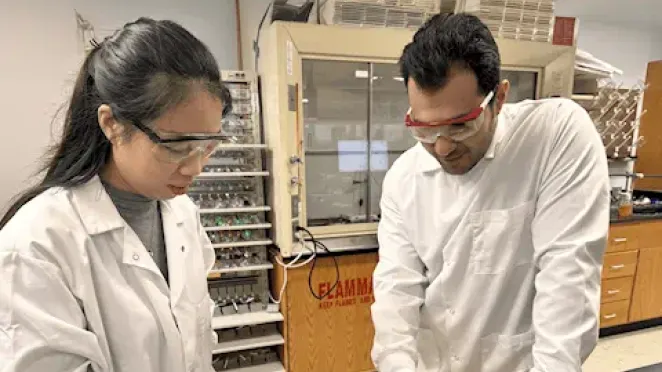
Jinxing Li receives $500K NSF Career Award
Read ArticleA researcher in the Michigan State University College of Engineering will use a National Science Foundation (NSF) Faculty Early CAREER Award to develop bioelectric tools to diagnose and treat digestive and neurological disorders.
ChEMS students win international AICHE honors
Read ArticleSpartan Engineering students involved in the student chapter of the American Institute of Chemical Engineers (AIChE) recently won top awards at the global association’s 2024 Student Conference Awards Ceremony in San Diego, California.
National Medal of Science awarded to oncofertility innovator, MSU Research Foundation Professor Teresa Woodruff
Read ArticleOne of the world’s leading fertility experts, Woodruff pioneered the science of oncofertility in 2006 so cancer patients could protect their reproductive futures. Oncofertility is now a globally recognized medical discipline with insurance and reimbursement available to patients and providers in many states and countries.
Henry Ford Health, MSU announce 2024 cancer research award recipients
Read ArticleHenry Ford Health + Michigan State University Health Sciences has named the award recipients of the 2024 Cancer Seed Funding Program. Building on the success of the 2022 and 2023 cancer research pilot and integration award funding initiatives, this year the program awarded 14 new cancer research awards totaling $700,000.
Automation Alley: Josh Siegel finds the big value in small data using the 'Pareto Data' strategy
Read ArticleThe Internet of Things (IoT) and Artificial Intelligence (AI) are cornerstones of many Industry 4.0 business strategies, enabling organizations to collect and process data at scale to intelligently optimize systems and processes.
$706,000 for lithium iron phosphate recycling
Read ArticleAs the industry surrounding electric vehicles (EVs) evolves, a lithium-ion battery is emerging that could have a market value of $35 billion by 2030. Considering the average life span of lithium-ion batteries is about 10 years, the need for innovative recycling strategies is becoming urgent.
Experiential learning for MSU engineering students gets a boost
Read ArticleThe PoliMOVE-MSU Indy Autonomous Challenge (IAC) racing team and the College of Engineering’s Technology Engineering program (TechE) have been awarded $200K by the DENSO North America Foundation (DNAF).
Innovations on display at 2024 Engineering Design Day
Read ArticleThe MSU College of Engineering invites you to a showcase of our best and brightest at the 2024 Fall Engineering Design Day on Dec. 6, 2024. One of MSU’s premier academic events, over 600 Spartan Engineering students will display their creative projects from 8 a.m. to noon in the Engineering Building, 428 S. Shaw Lane, East Lansing.
How undergraduate research fueled my success
Read ArticleNathan Denning is a civil engineering student and research assistant in the College of Engineering. Growing up in a military family, I was fortunate to live in and experience multiple places across the country, ranging from the suburbs of large cities to the island of Kodiak, Alaska, a community entirely powered by renewable energy.
MSU engineers help Spartan football team tune out the noise
Read ArticleUp until the 2024 college football season, a quarterback might be looking to the sidelines and relying on a sound, a sequence of hand motions, or a large sign with logos and symbols on it to get play information.

-
-

Our world-class academic team spans eight departments and two interdisciplinary programs
-

Learn about admissions and application processes for our world-class degree programs
-

Our world-class faculty and students engineer a healthier, safer and more sustainable world
-

MSU engineering students maximize early opportunities in the workplace and obtain competitive placements upon graduation
-
-

Sign up to receive the quarterly Spartan Engineering E-News packed with updates within the college