Security flaws could block devices from cellular networks
Read ArticleWhen a phone is lost or stolen, reporting it to a cellular carrier is supposed to prevent unauthorized use. Michigan State University researchers have found that weaknesses in the reporting system itself could potentially be exploited to block legitimate devices from cellular networks.
Quantum Motor City grows with NSF support to build future quantum workforce
Read ArticleAs quantum technologies move from research laboratories toward real-world applications, Michigan State University is helping prepare the next generation of students to take part.
Precision irrigation tools help farmers save water, energy and money
Read ArticleMichigan State University researchers are developing precision irrigation tools that help farmers make informed decisions, improve crop production and conserve water and energy.
July 2026 was among the driest on record across many parts of Michigan, according to National Weather Service data. When rainfall falls short, growers rely on irrigation to support their crops, making precise water use critical.
Spartan Engineers showcase expertise at 2026 ASABE Annual International Meeting
Read ArticleFaculty and students from Michigan State University’s Department of Biosystems and Agricultural Engineering brought research, leadership and student innovation to the 2026 American Society of Agricultural and Biological Engineers Annual International Meeting.
More than 70 Spartans attended the July 12-15 meeting in Indianapolis, delivering more than 60 technical presentations, serving on technical and leadership committees, councils and boards, and competing in research, design and robotics competitions.
Spartan Engineers help shape Michigan’s next mobility economy
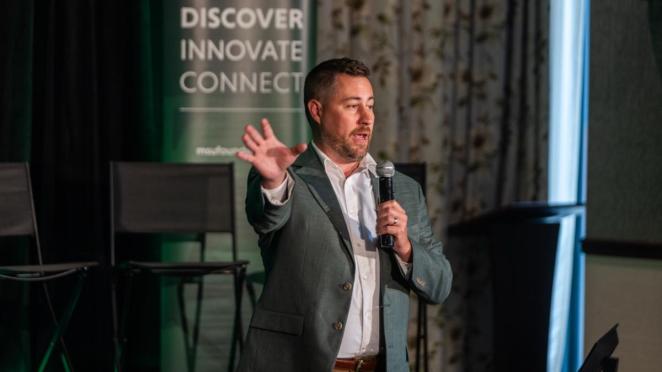
Read ArticleMore than 200 researchers, industry leaders, entrepreneurs, investors, policymakers and government partners gathered in East Lansing on Aug. 11 for the 2026 Mobility Summit, themed “Michigan Moves: Building the Next Mobility Economy.”
How insects could help detect PFAS contamination
Read ArticleResearchers at Michigan State University have discovered that neurons in a locust’s brain can distinguish among multiple PFAS compounds, including PFOS, one of the world’s most common “forever chemicals,” at environmentally relevant concentrations.
Research Spotlight: New system teaches AI how to selectively forget and make it more trustworthy
Read ArticleAs AI models evolve, we’ve seen how they harness the power of immense volumes of data. However, sometimes they tap into data they shouldn’t. When this happens, the system owner may be ordered by a regulatory agency or court to remove the data. Traditionally, when AI models needed to stop using data, the only reliable option was to rebuild the entire model from scratch. A new learning paradigm contributed by MSU researcher Sijia Liu allows AI models to selectively forget, or “unlearn,” specific data sets without the need to scrap the whole model.
John Albrecht to serve as Interim Associate Dean for Research
Read ArticleJohn Albrecht has been named interim associate dean for research for the College of Engineering at Michigan State University. His appointment begins Sept.1, 2026. Albrecht has been a professor in the Departments of Electrical and Computer Engineering and Chemical Engineering and Materials Science since 2012. He has served as the executive director of the University Research Organization (URO) in the MSU Office of Research and Innovation since 2022 and will continue in the leadership role while serving as interim with the college.
Beautiful science: Spartan research creates art
Read Article“I am among those who think that science has great beauty.” That sentiment from Nobel Prize–winning scientist and trailblazer Marie Curie comes to life every day in the work of Michigan State University researchers who develop breakthroughs and technologies that create a better world.
Great Lakes Crystal Technologies: Advancing diamond tech for next-gen electronics
Read ArticleFor decades, silicon has been the foundation of modern electronics because it is abundant, relatively affordable and well suited to the precise control of electrical current that makes computer chips possible. But today’s most advanced systems, from AI hardware to high-power and quantum technologies, are pushing silicon harder than ever, demanding more speed, more power and operation in hotter, harsher environments. As those demands grow, heat has become a major bottleneck: silicon remains essential, but it does not move heat nearly as well as diamond, making it harder to keep next-generation devices cool, compact and reliable.

-
-

Our world-class academic team spans eight departments and two interdisciplinary programs
-

Learn about admissions and application processes for our world-class degree programs
-

Our world-class faculty and students engineer a healthier, safer and more sustainable world
-

MSU engineering students maximize early opportunities in the workplace and obtain competitive placements upon graduation
-
-

Sign up to receive the quarterly Spartan Engineering E-News packed with updates within the college